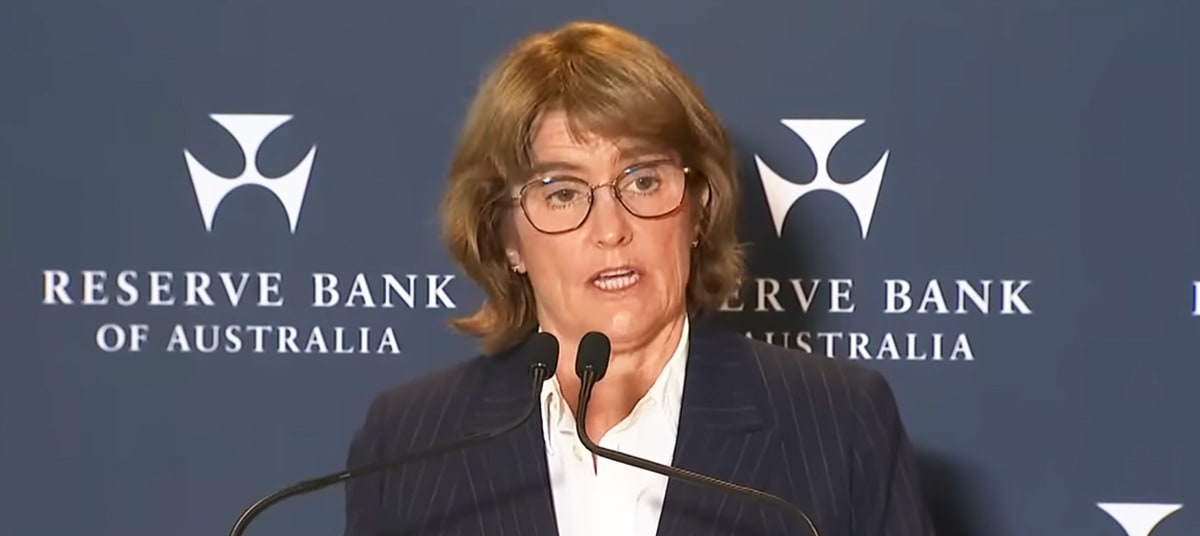
The latest cash rate hike has pushed rates into “restrictive” territory, according to Reserve Bank governor Michele Bullock, which she said provided the central bank with “space”.
The Reserve Bank of Australia’s latest interest rate hike took monetary policy into “a bit restrictive” territory, according to governor Michele Bullock, who argued that the move gave the central bank “space”.
Speaking at a press conference on Tuesday (5 May), Bullock said the decision to hike the cash rate from 4.10 to 4.35 per cent was driven by mounting evidence that the oil shock was starting to seep beyond petrol pumps.
“We’re already seeing that in many firms that are facing cost pressures,” she said.
“They’re looking to increase prices of their goods and services if left unchecked, higher costs get embedded into price and wage setting decisions.”
She cautioned that the central bank could not afford to ignore these dynamics.
“These second-round effects could lead to even higher and persistent inflation, and if so, would require even more tightening,” Bullock said.
She noted that the RBA’s latest call had taken monetary policy to “a bit restrictive” territory and added that “a restrictive” cash rate would help if inflation remained higher for longer.
Bullock also admitted that the three successive hikes had created room for the board to watch how the Iran war and its economic fallout unfolded – hinting there may be no immediate need for another increase.
“We’re now in a position where we’ve got space to be alert to the risks, if the war continues, and to sit and see what happens.”
Inflation risks versus recession fears
The governor made clear it was not a unanimous or easy call – explaining that the one dissenting member placed more emphasis on the threat to demand from higher oil prices.
“I think what was the difference for the one was they put more weight on the risk that the oil shock was going to have a big impact on demand,” Bullock said.
She further acknowledged that the board might well have had to raise rates even without the latest geopolitical shock.
“It’s possible,” the governor acknowledged, yet added that it had made the trade‑off “much worse”.
“It occurred (the conflict) at a time when inflation was already too high,” she said.
Bullock added that the three interest rate rises so far in 2026 “are not going to do anything for inflation in the next six months.”
“When I stood here in March, the war was maybe a week or two old, and everyone was thinking it’ll be over in a couple of weeks. It isn’t, we’re still here,” she said.
“Even if it is resolved quite quickly, the effects are going on for the rest of this year.”
Communication and the RBA’s increasingly challenging mandate
Bullock said deputy governor Andrew Hauser did not speak for the entire board when pressed whether his recent commentary on rates amounted to guidance.
“The answer to the question, is, no, he is not out there giving guidance,” Bullock said.
She stressed that neither Hauser nor any individual member could pre‑commit the institution.
“(Haueser’s) not guiding the market because he doesn’t actually know what the board is going to say,” Bullock said.
Bullock did not conceal her concern about the growth outlook or recession risks and said the RBA’s forecasts had economic growth slowing to about 1.3 per cent, which she described as “pretty anemic”.
“We are all feeling poorer and there is no way out of that. That's what this war has done, on the other side of the world.”
In a frank admission – Bullock conceded the board may not have perfectly balanced its objectives.
“It’s possible that we have given too much weight to the inflationary risks, and we haven’t given enough weight to the possibility that consumption will pull back quite a lot,” she said.
“We don’t give equal weight to both, it depends a little bit on where we think the relative risks lie."
The RBA now expects inflation to peak at around 4.8 per cent midyear and not slipping back below 3 per cent until June 2027.
“It's tough, it's a very tough time,” Bullock said.
Chalmers flags ‘tougher’ conditions ahead of budget
Federal Treasurer Jim Chalmers responded to the RBA’s move by highlighting the twin pressures of the war and tighter policy on an already stretched economy.
He said Australians were “paying a hefty price for the war in the Middle East and this decision will make it tougher.”
At the same time, he took aim at critics who claimed the government’s fiscal stance was to blame for high inflation and rates.
“To those people who are pretending that the government’s budget is the sole driver of prices in our economy or interest rate decisions, they weren’t saying that last year when interest rates were cut three times,” he said.
With the budget due on 12 May, Chalmers reinforced his message of fiscal restraint amid global turmoil.
He pledged to deliver a “responsible budget” that “saves more than we spend” as the Australian economy “is absolutely pummelled by the war in Iran”.
Bullock said, “governments are spending a lot of money, and we're running up against capacity constraints, then they do need to think about whether or not there are ways they can help the inflation problem by looking for ways to constrain demand.”
The governor emphasised that fiscal choices at all levels of government mattered and warned that policies designed to shield households from higher living costs could blunt the impact of higher rates.
“All I’m saying is that the extent to which the government make up the shortfalls for households by giving them more money – it makes it harder to dampen demand,” Bullock said.
ANZ sees June pause, warns of increasing August risks
ANZ’s head of Australian economics, Adam Boyton, said the bank still expected a pause at the next meeting, but noted that the balance of risks had shifted.
“By August – in the absence of a rapid resolution to the conflict in the Middle East and a resumption of oil flows – we expect the activity data in Australia to be looking sufficiently soft to keep the RBA on hold,” he outlined.
“That said, risks would now appear more skewed to a rate hike in August than prior to this meeting.”
ANZ, Commonwealth Bank of Australia and National Australia Bank all predicted a single May hike followed by an extended hold period, while Westpac is forecasting two more hikes in June and August.
[Related: RBA reveals latest cash rate decision]
Want to see more stories from trusted news sources?
Make The Adviser a preferred news source on Google.
Click here to add The Adviser as a preferred news source.