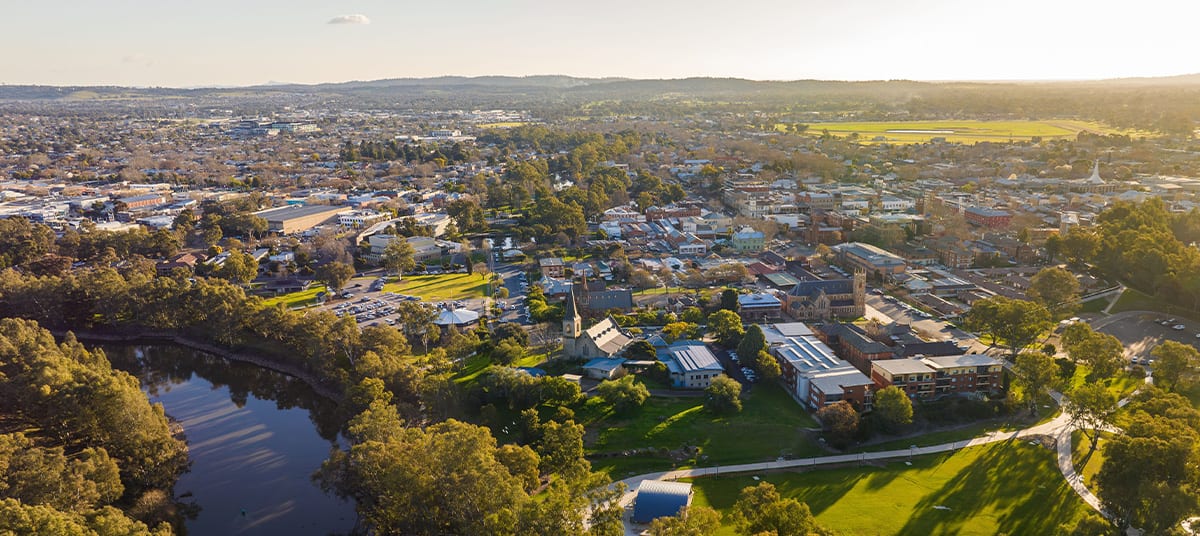
Wagga Wagga City Council is calling on federal government to investigate the feasibility of establishing a government-owned bank.
The NSW city of Wagga Wagga has agreed to call on the federal government to investigate the possibility of establishing a government-owned bank in post offices as a means of ensuring local residents have access to banking services.
According to a Senate inquiry on regional banking in 2023, 36 per cent of bank branches in regional Australia have closed since 2017.
The issue has been particularly problematic for residents in remote cities and towns, who may have to travel hundreds of kilometres to find their nearest bank branch.
At a council meeting on Monday (19 January), Wagga Wagga City Council noted the ongoing closure of regional bank branches across Australia, alongside the growing pressure on post offices in similar locations, and agreed to pursue a range of actions to ensure residents are able to access in-person banking services.
Councillor Richard Foley presented a notice of motion addressing concerns for banking and postal services in regional Australia, in response to the 2023–24 Senate inquiry into bank closures in regional Australia.
In his motion, Foley said: “Regional banking and postal services are facing unprecedented degradation. Major banks continue shutting down branches throughout regional Australia, frequently closing the last remaining branch in towns that have relied on these services for decades…
“Simultaneously, Australia Post is pursuing a corporate strategy of reducing the number of full-service post offices, replacing many with parcel-only facilities, and transitioning from perpetual licences to fixed-term licences for licensees. This will allow further closures and the downgrading of essential services.
“Without urgent action, regional communities, including those within the Wagga Wagga Local Government Area, will continue to face reduced access to essential services that underpin the economic and social wellbeing of our residents and small businesses.”
Wagga Wagga City Council noted the ongoing closure of regional bank branches across Australia and “the growing pressure this places on already-stretched post offices, which are also facing closure or downgrading of services”.
It is therefore calling on the Albanese government to acknowledge the findings of the 2023–24 Senate inquiry into bank closures in regional Australia, which is yet to receive a formal government response.
Wagga Wagga City Council has now pledged to write to the Prime Minister, the Treasurer, and the Minister for Communications requesting an urgent response to the Senate inquiry report, commitment to its recommendations, and “commissioning of an expert panel to investigate the establishment of a government post office bank”.
The council is also calling on the federal government to designate access to banking and cash as an essential service and recognise the “significant and predictable negative impacts these closures have on regional communities, small businesses, older residents, and local economies reliant on reliable access to cash and essential services”.
Speaking to the motion, Councillor Foley, a member of the Citizens Party, said: “Bank closures are not just an inconvenience; they are fundamentally changing people’s way of life and the way they do business.
“When the banks leave the pressure doesn’t disappear, it shifts.
“Post offices are forced to pick up the slack… at the same time Australia Post itself is moving towards a model that reduces full-service postal services.
“So what we are seeing is a double failure: banks withdrawing services, particularly from the bush, and post offices being hollowed out.”
Supporting the motion, Councillor Jenny McKinnon said: “I totally agree with the premise that our rural and regional communities are suffering badly with the situation as it’s developed in the banking services sector, and I would hate to see post offices go the way, where I know many people currently rely on the post office for their cash transactions, if they are reduced that would be a huge concern.”
Mayor Dallas Tout also supported the moves and stated: “Any pressure that can be put on to have the federal government try and stop closing the post offices, because if we don’t have the post office, that’s less places we can have a post office bank.”
Citizens Party national chairman Robert Barwick called on other councils to follow Wagga Wagga’s lead and join in pressuring the Albanese government to act.
He said: “We have a crisis in banking and postal services, but we also have a solution, recommended by a major, all-party Senate inquiry, except the government is ignoring it.
“City of Wagga Wagga is leading on this because local government is closest to the crisis. If enough Councils add their voice they can’t be ignored.”
What is being done?
The Senate inquiry into bank closures in regional Australia held 13 public hearings over 15 months and issued a bipartisan report in 2024, putting forward eight core recommendations.
These were:
- Recommendation 1: The Australian government should recognise access to financial services as an essential service and guarantee reasonable access to cash and banking services for all Australians.
- Recommendation 2: The government should commission an expert panel to assess the feasibility of establishing a publicly owned bank, including options such as a stand-alone entity or one linked to Australia Post’s branch network.
- Recommendation 3: The government should urgently introduce a mandatory Banking Code of Conduct, overseen by a consumer-focused regulator, requiring consultation, impact assessments, transition support, and regulatory approval before any bank branch closure.
- Recommendation 4: The regulator enforcing the Banking Code should have the power to approve or defer branch closures, direct further action by banks, and impose penalties for non-compliance.
- Recommendation 5: The government should task the ACCC with investigating barriers to customers switching banks to help institutions that maintain regional, rural, and remote branches attract more business.
- Recommendation 6: The government should establish a Regional Community Banking Branch Program to help fund community bank branches in regional areas, supported by a hypothecated supplement to the Major Banks Levy.
- Recommendation 7: The government should require all major banks to participate in harmonised Bank@Post agreements with improved terms, with non-participating banks subject to a higher supplementary levy.
- Recommendation 8: The ACCC should consider measures, including limited exemptions from competition laws, to allow banks to co-operate in protecting access to banking services in regional, rural, and remote communities.
However, the recommendations have not received a formal federal government response.
While the major banks have agreed to halt any further branch closures until mid-2027, several non-major and community banks have been closing their doors recently.
For example, People First Bank announced earlier this month that it would close 18 sites across Australia from 12 March, including several in regional towns. According to the bank, less than 1 per cent of its transactions occur in branches, and fewer than 0.7 per cent of its customers use a branch regularly.
The branches to close are Coomera, Hervey Bay, Kawana Waters, Kippa-Ring, Macquarie Park, Millmerran, Oakey, Pittsworth, Runaway Bay, Toowoomba Range, Tweed Heads, Wilsonton, Blackwood, Millicent, and Caroline Springs. The Laidley, Goondiwindi, and Maryborough agency outlets will also close.
Last year, the National Party of Australia urged banking chiefs to keep regional services open and stop branch closures amid an ongoing campaign to maintain face-to-face services in rural and remote areas.
Shadow assistant treasurer and shadow minister for financial services, Pat Conaghan, confirmed he had met with major banks serving regional areas in August and September and claimed he had “thrown down the gauntlet” on regional banking.
On 15 August, the Nationals wrote to the Treasurer and Assistant Treasurer calling for an urgent response to the Senate inquiry on regional banking.
[Related: Nationals ‘throw down the gauntlet’ on regional banking access]
Want to see more stories from trusted news sources?
Make The Adviser a preferred news source on Google.
Click here to add The Adviser as a preferred news source.