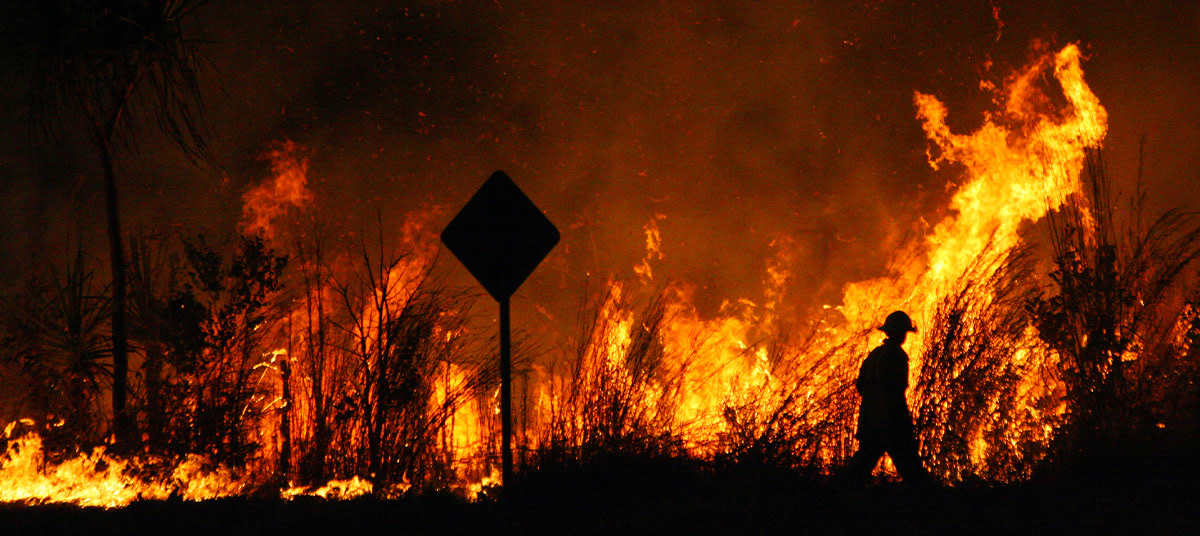
Victorians affected by the ongoing bushfires may be able to access a range of financial, mental health, and practical support measures, with governments and banks rolling out disaster relief.
Over the weekend, large swathes of Victoria – including Bendigo, Gippsland, Natimuk, and Harcourt – experienced devastating bushfires stoked by a heatwave in dry and windy conditions, leading to the loss of one life, 350,000 hectares of the state burnt out, and resulting in the loss of more than 350 structures.
More than 8,000 hectares of land have been burnt out in Natimuk, western Victoria, alone (one of the areas worst affected by fire), as many parts of the country saw temperatures climb to over 40 degrees on Friday and Saturday.
A state of disaster has been declared across 18 local government areas and one alpine resort. A state of disaster – which gives authorities extra powers to confront an emergency of extraordinary scale and danger – is now in place for:
- Alpine Shire
- Ararat Rural City
- Colac Otway Shire
- Corangamite Shire
- East Gippsland Shire
- Golden Plains Shire
- Greater Bendigo City
- Horsham Rural City
- Lake Mountain Alpine Resort (Unincorporated)
- Mansfield Shire
- Mildura Rural City
- Mitchell Shire
- Moira Shire
- Mount Alexander Shire
- Murrindindi Shire
- Pyrenees Shire
- Strathbogie Shire
- Towong Shire
- Wellington Shire.
The Allan and Albanese Labor governments have now announced multiple support packages following fires that have torn through large parts of the state.
An initial $19.5 million support package has been jointly funded under the Commonwealth-State Disaster Recovery Funding Arrangements (DRFA), building on activated Personal Hardship Assistance Program payments for those forced to evacuate.
Assistance is also being made available to households that have suffered major losses. The Albanese and Allan governments are offering payments of up to $52,250 to eligible uninsured households to help them re-establish their principal place of residence after losing their home in the fires.
In addition, under the hardship program, eligible Victorians can access a one-off payment of $680 per adult and $340 per child, up to a maximum of $2,380 per family, to cover immediate needs such as food, clothing, and medicine.
Targeted support is also being extended to farmers and regional communities impacted by the loss of livestock, crops, and agricultural businesses.
A $10 million emergency support program will be established to help distribute fodder to affected farmers, while the Victorian government is expanding mental health and wellbeing services for primary producers.
This includes free, confidential wellbeing support, as well as financial and business counselling through the Rural Financial Counselling Service. Wellbeing counsellors will be available to visit bushfire-affected producers and their families on their properties or provide support over the phone.
From Friday, 16 January 2026, grants of up to $5,000 will be available to fund events and activities that support mental health and wellbeing in farming communities.
To help co-ordinate recovery, governments will also establish a single Recovery Support Program, backed by $5 million in funding, with case support workers assisting affected Victorians to navigate housing, legal, financial, and practical support. A further $2 million will fund a recovery hotline.
More support is expected to come as further impact assessments are done when it is safe to do so.
Prime Minister Anthony Albanese said the federal government was working closely with the state.
“The Federal Government is working hand in hand with the Victorian Government to provide immediate support for communities impacted by the devastating bushfires,” the Prime Minister said.
Speaking during a visit to Natimuk, one of the worst-hit communities, Victorian Premier Jacinta Allan said the additional support was aimed at easing both financial and emotional pressures.
“These fires have caused unimaginable loss for so many across Victoria – that’s why we are delivering more financial and mental health support to help ease some of the burden facing our farmers and regional communities,” Allan said.
What can borrowers do?
Alongside government assistance, Australian banks have begun activating disaster relief measures for affected customers, including repayment holidays on loans and credit card repayments, fee waivers, and emergency grants.
Major banks have confirmed they are rolling out tailored disaster relief packages, offering repayment deferrals, fee waivers, emergency credit, hardship support, and grants to cover urgent expenses, such as accommodation, food, and clothing.
NAB executive Belinda Mamet said: “These bushfires are having a devastating impact on families, businesses and entire communities across northern Victoria.
“We know people need help now, not later. That’s why we’re offering $1,000 Disaster Relief Grants to cover urgent costs like accommodation, clothing and food.
“We’ve also put in place a range of measures, including loan repayment deferrals and fee waivers, to ease financial pressure during this incredibly difficult time.”
Damien MacRae, Westpac’s general manager for retail banking, said: “Westpac stands ready to support customers affected by the Victorian bushfires.
“Our Disaster Relief Package provides immediate financial assistance and tailored support, enabling people to focus on keeping their families safe and helping their communities recover.
“If you need help, please reach out as soon as it’s safe to do so.”
The CEO of the Australian Banking Association (ABA), Simon Birmingham, said banks were on standby to assist households, farmers, and businesses.
“This is an extremely challenging time for many Victorian communities, households and businesses,” Birmingham said.
“There are now special arrangements in place for those who may need additional financial assistance from their bank in the coming days, weeks and months.
“Practical support options are available from loan and credit card payment deferrals through to loan restructuring to help you get back on your feet.”
To support longer-term recovery, the Victorian government has also launched the 2026 Victorian Bushfire Appeal, with 100 per cent of donations going directly to fire-affected communities.
Donations opened online on Monday (12 January), with funds directed to immediate and longer-term assistance identified by affected communities.
“We know there are so many Victorians out there who want to dig deep to support our farmers and fire-affected communities – that’s why we have set up the Victorian Bushfire Appeal,” the Victorian Premier said.
Extreme weather plays havoc across Australia
The support for Victorian bushfire victims comes as other parts of the country also grapple with extreme weather, with north-west Queensland recently experiencing widespread flooding after receiving more than a year’s worth of rainfall in just days.
As reported by The Adviser last week, governments and banks have similarly rolled out disaster relief for flood-affected Queenslanders, including hardship assistance from lenders, repayment deferrals, fee waivers, and emergency credit, alongside government-backed low-interest loans and disaster recovery grants for primary producers and regional communities.
The concurrent crises have renewed warnings from industry and policymakers about the growing financial and emotional toll of extreme weather events on households, farmers, and small businesses across Australia.
Indeed, a recent federal climate risk report warned that the cost of extreme weather as a result of climate change could be nearly half a trillion dollars.
The Australian government’s National Climate Risk Assessment (NCRA) – the first report to collate evidence on how climate risks are, and will be, experienced in Australia – was released in September last year and modelled the impacts of different global warming levels that are likely to be reached, including a 1.5-degree, 2-degree, and 3-degree increase.
Under a high-emissions scenario, climate change could drive up to $571 billion in housing value losses by 2030, significantly increase heat-related deaths, constrain future access to loans and mortgages, and has prompted the government to roll out a National Adaptation Plan to address the growing risks.
[Related: Government and banks offer support for Qld flood victims]
Want to see more stories from trusted news sources?
Make The Adviser a preferred news source on Google.
Click here to add The Adviser as a preferred news source.