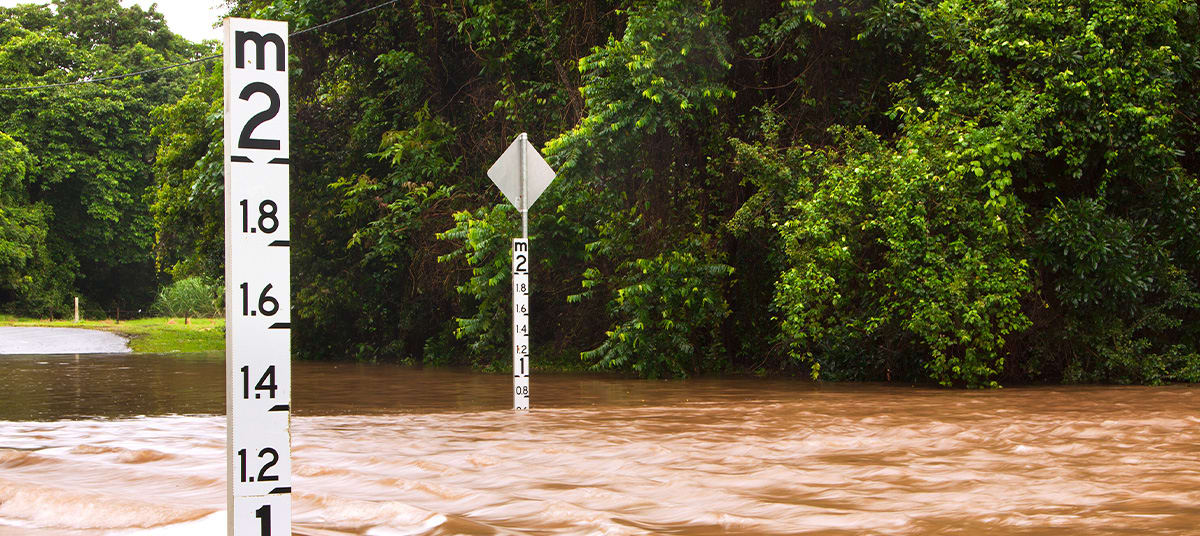
Borrowers impacted by flooding in north-west Queensland may be able to access disaster relief from their lenders and new disaster recovery grants from the government.
A significant weather event impacting the Cloncurry Shire and the Greater North West region has resulted in over a year’s worth of rainfall in the last few days (with some areas receiving more than 800 millimetres of rain since 25 December), causing widespread flooding to cattle stations and farms, mines, as well as washing out roads, the local airport, and isolating communities.
According to Queensland’s Minister for Emergency Management, Kristy McBain, 83 per cent of primary producers have indicated that they will have catastrophic or major losses as a result of the flooding, with around 16,000 head of cattle reported to be either deceased or lost.
Over 1,400 kilometres of private roads are also believed to be washed out, with roads between Townsville and Brisbane impacted, with expectations that parts of these northern communities will remain isolated for the next few weeks, given the wet season.
Lenders have begun announcing disaster relief support for impacted borrowers, with most offering hardship assistance to flood victims, such as repayment deferrals on their loans and credit card debt, waiving fees for restructuring existing loans, and offering emergency credit limit increases or additional finance to help cover cash flow shortages.
Some lenders, such as ANZ, are also making those with emergency funds and temporary accommodation available to those with eligible home and contents insurance.
ANZ Group Managing Director, Queensland, Bruce Rush said: “The heavy weather has already affected homes, businesses, and infrastructure across North Queensland, with rainfall and flooding continuing to pose further risks. The safety of our customers and colleagues is our highest priority, and we will continue to monitor the event as it progresses.
“Our relief package is here to provide essential support and financial relief, giving customers a sense of stability and peace of mind as they navigate uncertainty and begin to rebuild,” Rush said.
A spokesperson from the Commonwealth Bank of Australia (CBA) told The Adviser that the bank is proactively checking in with customers in the impacted areas to work on providing support, and encouraged impacted customers to reach out to so they can provide "support based on their individual circumstances".
Like ANZ, they are also making available temporary accommodation for customers who have taken out home insurance provided by Hollard, distributed by CBA. CBA's business customers may also be able to have early access to term deposits, cash deposit, farm management term deposit and business investment accounts.
The CEO of the Australian Banking Association (ABA), Simon Birmingham, urged anyone who may be concerned about their financial situation as a result of the floods to reach out to their bank to see what support they can provide
“Banks recognise the significant financial and emotional toll an extreme weather event like this can take,” he said.
“It doesn’t matter if you’re an individual, a farmer or a small business customer, banks have a range of financial assistance available from repayment deferrals through to loan restructuring to help you get back on your feet.
“You don’t have to tough it out on your own, the sooner you reach out to your bank the quicker financial help can be put in place.”
Government support made available
Low-interest loans (carrying an interest rate of 2.14 per cent) of up to $250,000 are also being made available through the Queensland Rural and Industry Development Authority (QRIDA). If needed, up to two years interest-only may be available.
The Albanese and Crisafulli governments have also committed an additional $38 million towards large-scale disaster recovery efforts for flood-affected communities, farmers, and communities across north-west Queensland, including $21.5 million for primary producer Disaster Recovery Grants up to $75,000.
Impacted farmers in Carpentaria, Cloncurry, Croydon, Flinders, McKinlay, Richmond, and Winton Shires may be able to access the grants, including upfront payments of $10,000.
Another $5 million investment will grow the region’s Coordinated Emergency Fodder Support Package to $7 million, helping primary producers keep their stock fed in Carpentaria, Cloncurry, Flinders, McKinlay, Richmond, and Winton.
Around $11.5 million will go towards works to repair the damaged airstrip and increase the airport’s capacity to accommodate larger aircraft.
Announcing the funding on Tuesday (6 January), Prime Minister Anthony Albanese commented: “These disaster packages will make sure flood affected Queenslanders can recover and importantly build back stronger.
“We want all Australians to know that their government has their back.”
Acting Premier of Queensland Jarrod Bleijie added: “We’ve got boots on the ground across the north and north-west to inform our recovery and the support we’re providing.
“It doesn’t matter what we’re up against, we’ll continue delivering for Queensland.”
2026 kicks off with extreme weather
The support comes amid a confluence of extreme weather across Australia. While northern Australia has been experiencing floods and monsoon events, the west and southern parts of the country are currently in the grips of a heatwave, which will be moving northwards over the next few days.
Large parts of the country will be experiencing temperatures rising above 40 degrees through the second half of this week.
Temperatures in South Australia are expected to hit 47 degrees today (8 January), according to the Bureau of Meteorology, while Western Australia has seen some areas hit 45 degrees over the past few days. While these two states typically experience heatwaves (three or more days of very hot weather) this time of year, the prolonged run of very hot days and nights – coupled with potential dry lightning strikes and strong winds – has increased bushfire risks.
Victoria and southern NSW have also seen temperatures in the high 30s over the past 24 hours, with inland ACT and some parts of NSW expecting temperatures of between 44 and 46 degrees on Thursday.
Saturday will be the warmest day of the week in Sydney, at 39 degrees, with the western Sydney suburbs of Penrith and Parramatta expected to reach temperatures in the low 40s on Friday, which will remain there until Sunday.
Cooler temperatures are expected to arrive for most of the country by Sunday.
A half-trillion dollar problem
Changing climate has been of major concern for the Australian government, with a major report last year revealing that losses in Australian property values could soar to $571 billion by 2030 under a high-emissions scenario.
The Australian government’s National Climate Risk Assessment (NCRA) – the first report to collate evidence on how climate risks are, and will be, experienced in Australia – was released in September last year and modelled the impacts of different global warming levels that are likely to be reached, including a 1.5-degree, 2-degree, and 3-degree increase.
In the worst-case scenario modelled, in which temperatures rise by 3 degrees, or a ‘high emissions’ scenario, the number of deaths due to extreme heat could rise fivefold.
In addition, damage-related losses to housing values could total $571 billion by 2030, $611 billion by 2050, and $770 billion by 2100.
Climate risks could result in increasingly limited access to loans and mortgages, as lenders evaluate climate change in credit risk, the report outlined.
Commenting on the report’s findings at the time, Minister for Climate Change and Energy Chris Bowen said: “Australians are already living with the consequences of climate change today but it’s clear every degree of warming we prevent now will help future generations avoid the worst impacts in years to come.”
In response to the report, the Australian government released a National Adaptation Plan – a policy framework on how it plans to respond to the risks.
Going forward, the Australian government said it “will work with states, territories and local government to create an action agenda for this plan”.
[Related: Climate change could strip $500bn from property by 2030]
Want to see more stories from trusted news sources?
Make The Adviser a preferred news source on Google.
Click here to add The Adviser as a preferred news source.