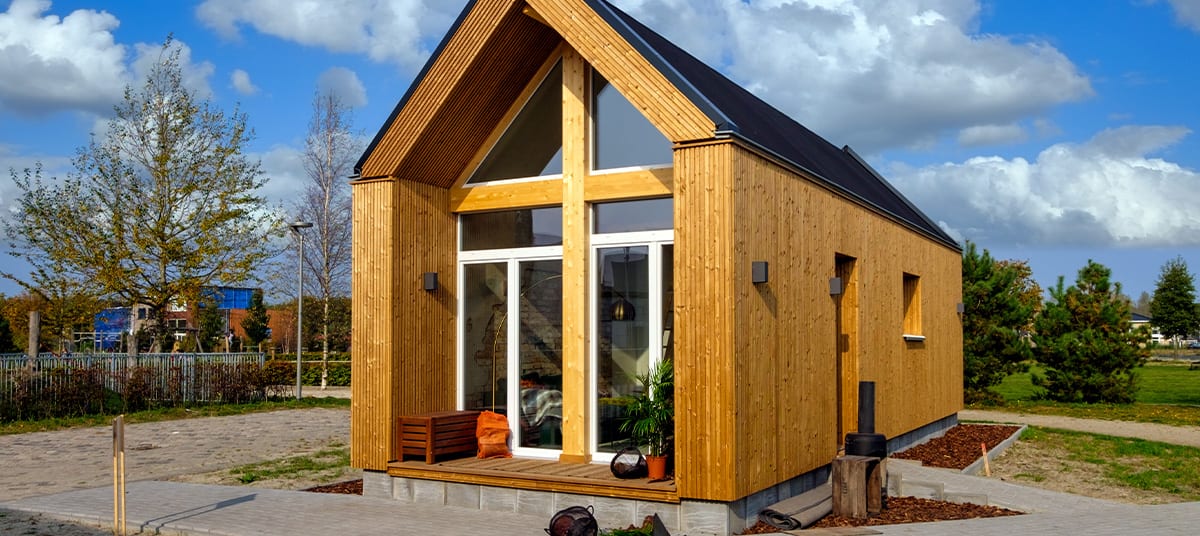
Australians are flocking to DIY kit homes and tiny houses as affordability bites, with inquiry volumes and finance leads surging.
Specialist brokers are reporting unusually strong inquiry volumes for tiny homes, as affordabilty pressures lead more home buyers look for alternative solutions.
Speaking to The Adviser, Jamie Mitchell, senior asset broker at Great Escape Finance, said demand had spiked even though home buying activity is typically subdued over Summer.
“Traditionally, this time of the year can be quiet due to the holiday season, but we are experiencing a rush as big as any we’ve had in the last four to five years. We are seeing close to a 50 per cent increase on leads,” Mitchell said.
He said that tiny homes were no longer an “alternative lifestyle” choice and stressed that they could help ease the nation’s housing shortfall.
Yet he said the real challenge was ensuring dwellings were safe and fit for purpose, pointing out that the National Construction Code (NCC) still had no dedicated category for tiny homes.
“Unfortunately, most tiny homes cannot pass the Class 1A standard because recent additions require a 7‑star energy rating and wheelchair accessibility,” he said.
Mitchell added that an NCC amendment for tiny homes would make them “a very viable option for those who can’t afford a traditional mortgage yet”, with many buyers currently using them as a stepping stone as they rent or pay down debt.
Financing the unconventional build
However, Mitchell described tiny‑home funding as complex and heavily dependent on security and ownership structures.
He said as recently as four years ago, there were effectively no mainstream lenders willing to finance tiny homes, prompting Great Escape Finance to use private lenders.
He outlined that the firm later brokered a trial with MoneyPlace to offer unsecured personal loans specifically for tiny homes – a model he said had since been adopted more broadly.
Since then, he has observed further product evolution, including a major bank modular‑build product that operates similarly to a construction loan.
“Since personal loans came to market, we have seen the CBA offer a product for modular builds, similar to a construction loan. This is suitable for those who have some savings and own land approved for development,” he said.
“We have also seen several commercial lenders who allow tiny homes for reasonable business purposes.”
However, he explained that security remained the sticking point.
“When taking out a mortgage, the lender will take security over the title – yet lenders cannot yet take the tiny home as security because the associated risk is too high,” he said.
Mitchell noted that one unnamed lender allowed borrowers to take security over the tiny home itself, but with the significant caveat of preventing them from using it as their principal place of residence.
Security and family land
Similarly, Lennox Head‑based broker and ZEP Finance director, Zain Peart, told The Adviser he was hearing from numerous clients who wanted to position tiny homes either on their own land or on property owned by family members. This demand has come as construction costs for traditional houses have blown out, development approvals have hit delays, and the cost of land has also increased.
“We are often hearing about many people wanting to put a tiny home on their property or on one of their family members’ properties – this is quite common in our area, but I am hearing about this in a lot of other areas as well,” he said.
“Demand has been increasing over the last few years, and I believe we will continue to see this increase as time goes on.”
Yet he stressed that funding was the primary obstacle.
“The problem is the funding of this sort of property, there is also the issue that if it is not installed correctly, it could actually detract from the value,” Peart said.
On practical financing structures, Peart said the path depended on who owned the underlying real estate and what security could be offered.
“There are some unsecured options that would have a higher interest rate in the shorter term, and if you own the property and have equity, you could look at doing a straight equity release – yet this would only give them the money to buy the property,” he said.
He added that younger buyers often relied on their parents to unlock equity.
“A lot of younger people are looking to get these types of properties onto their parents’ land, in this situation, they do not have security, and I’ve seen parents borrowing for the kids,” Peart said.
A shifting customer base and policy gap
Mitchell said the tiny‑home demographic had shifted markedly over recent years.
“Traditionally, it was people who wanted an alternative lifestyle. Now, it is much more young working families or single professionals looking at tiny homes as options,” he said.
He added that once construction codes were updated and councils could readily treat them as suitable dwellings, tiny homes would likely become more mainstream.
Peart agreed that relocatable and modular housing deserved more attention in the policy conversation.
“Tiny homes are certainly something that needs to be talked about – the modular or relocatable homes are definitely a way to make housing more affordable,” he said.
The emerging trend comes amid rising demand for tiny homes. According to Kit-home provider Shed House, there has beena 340 per cent growth in DIY home inquiries in January (compared to January 2025), underscoring the rapid acceleration of owner‑builder interest.
The company also recorded a 221 per cent uplift in inquiries between July and December 2025 versus the first half of that year.
According to Shed House, Queensland is leading the new wave of DIY building, with a 373 per cent increase in January inquiries, placing it ahead of Victoria and Western Australia as a hotspot for kit‑home activity.
Director Katie Penfold said the trend was particularly pronounced among younger households.
“Many of our customers are young families who want a more affordable way to build a home that suits their needs,” she said.
[Related: Construction costs lift despite annual increases hitting new lows]
Want to see more stories from trusted news sources?
Make The Adviser a preferred news source on Google.
Click here to add The Adviser as a preferred news source.