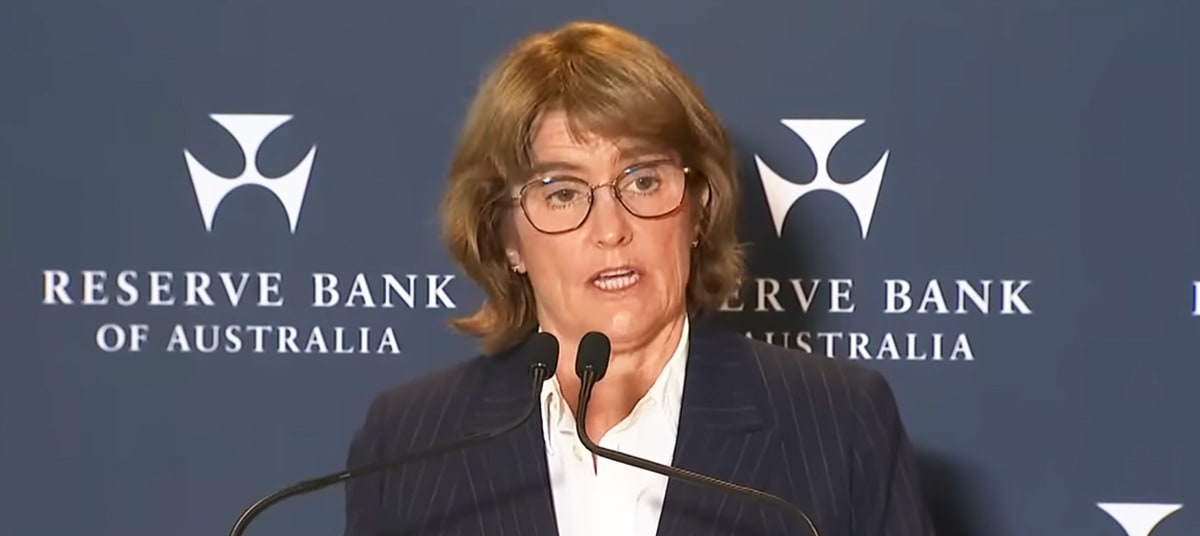
In a fiery press conference, Reserve Bank governor Michele Bullock spelled out why the Reserve Bank had hiked the cash rate, stressing that entrenched inflation rather than rising petrol prices alone – forced its hand.
RBA governor Michele Bullock, speaking in Sydney on Tuesday (17 March) after the Monetary Policy Board lifted the cash rate to 4.10 per cent in a narrow 5–4 decision, set out in detail how the board weighed a “hawkish hold” against an immediate move and how the Middle East oil shock had complicated an already difficult inflation fight.
‘Higher petrol prices’ not ‘the reason for today’s decision’, Bullock insists
Bullock began by pushing back at the idea that surging fuel costs were the primary trigger for Tuesday’s hike.
“Higher petrol prices will add to inflation, but they’re not the reason for today’s decision. Inflation was already too high, reflecting the fact that demand is outstripping supply, higher fuel costs will not slow demand enough on their own to address this,” she said.
She revealed that the board had spent two days debating whether to wait until the May meeting, but said that members had ultimately judged that delaying would allow price pressures to spread further.
Explaining the narrow vote, Bullock said all members agreed on the direction – this being high inflation and that expectations needed to decline – yet diverged over timing and risk‑weighting.
“Where the difference was in the timing, the members that voted to hold were voting to hold in a hawkish sense. They thought that maybe it was prudent just to wait another seven weeks and just see if the uncertainty was still there,” Bullock said.
She likened the divide to last year’s split July meeting, when a minority favoured cutting rates earlier, while the majority opted to wait.
Bullock says inflation risks now outweigh unemployment concerns
Pressed on how much weight the board had placed on the labour market, Bullock said members still scrutinised employment conditions closely, but now believed that there was more risk on the inflation side.
“I think there’s general agreement that the labour market is in a much better shape than we thought it was and that the risks now are more on the upside for inflation,” she said.
Bullock reiterated that the RBA’s strategy was to return inflation to the 2–3 per cent target, while retaining as many of the employment gains of recent years.
“The Board’s strategy has still not changed,” she said.
She also emphasised that the board understood the impacts higher repayments would have on households, which were already dealing with rising fuel bills, but said that failing to act would ultimately be more damaging.
“My issue, though is that in the Board’s opinion was that if we wait on rates and we see prices and fuel prices jump, they’ll go into supply chains,” she said.
“Obviously going to go into businesses costs and so on. If we don’t bring the excess demand down, then businesses are just going to build that into their costs.
“It is hard, I understand that, but it is the only instrument we have, and it is important that we get inflation down.”
Bullock also confirmed that the board did not consider a 50‑basis‑point move.
“A 50-bp hike is a lot,” she said.
Bullock said that the RBA hadn’t crunched the numbers as to how surging fuel costs would hit the economy.
“We haven’t done any modelling on potential impacts. Treasury is looking at that, but we haven’t done anything on that yet,” Bullock said.
Oil shock, energy subsidies, and global backdrop
Bullock said the war in the Middle East had intensified the inflation challenge by pushing up global oil prices and had added another layer of uncertainty to the outlook.
She also pointed to the broader global policy backdrop and said that most major central banks, with the exception of Japan, were leaning towards higher rates.
She said the RBA was “not certain” as to how restrictive overall financial conditions were, in part due to the fact that inflation had remained “high and unacceptably high.”
On the possibility of a recession, Bullock was frank and said that while the bank did not want to trigger a downturn, it could not be ruled out if inflation continued to prove sticky.
“We don’t want to have a recession, but if it’s hard to get inflation down, then you know we’re going to have to deal with that possibility,” Bullock said.
Bullock also said that potential government subsidies aimed at lowering fuel prices would, by definition, have inflationary implications.
“I don’t know what governments are going to do, but if there are subsidies for certain things, then yes, that will have an impact on headline inflation,” she said.
Bullock rebuffs ‘hawkish signal’ claims
A significant portion of the press conference was devoted to questions about whether Bullock and deputy governor Andrew Hauser had effectively pre‑signalled Tuesday’s decision through recent public commentary, with Bullock rejecting those suggestions outright.
“I would actually push back against that entirely,” she said.
“All I said in my remarks was that March is a live meeting, every meeting is a live meeting.
“The deputy governor, as far as I can tell, did not express a view one way or the other. So, I would push back against that.”
She described it as a “misinterpretation” to read Hauser’s appearance on the Politics with Michelle Grattan podcast as a signal that the board would be raising the cash rate.
“I think if you read what he said, you’ll see he was giving an argument on both sides,” she said.
“It would be entirely inappropriate, I’ve said this before – and he would agree with this – for either of us to front run the board, because you don’t know, the board might disagree with you.”
When asked directly whether she was defending a rate hike she did not personally vote for, Bullock declined to be drawn in.
“I’m going to answer that,” she said.
Chalmers: Middle East conflict ‘making the challenge harder’
Federal Treasurer Jim Chalmers, speaking at a press conference in Canberra on Tuesday, said the RBA’s decision came against a backdrop of global risks that were bearing down on an economy that was already wrestling with high inflation.
“These global risks are very substantial, we’re not immune from them, but we are better placed than most to deal with them,” Chalmers said.
He stressed that Australia had entered the latest conflict‑driven shock with an existing inflation problem and that the war in the Middle East was now compounding that challenge.
“Developments in the Middle East are making that challenge harder, rather than easier,” he said.
Chalmers emphasised that the board had acted independently, yet framed the move as a response to both domestic price pressures and “very substantial global economic volatility and uncertainty”.
[Related: RBA hikes cash rate as Middle East conflict bites]
Want to see more stories from trusted news sources?
Make The Adviser a preferred news source on Google.
Click here to add The Adviser as a preferred news source.