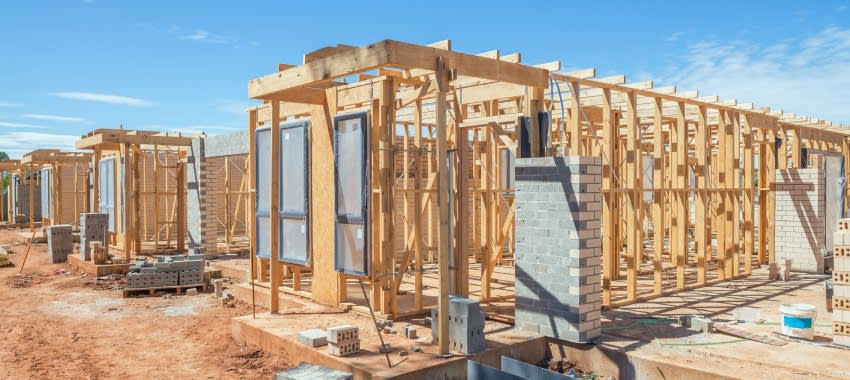
Fresh data has shown January building approvals sliding after higher‑density housing dropped sharply, yet non‑residential projects powered ahead.
Australia’s home‑building pipeline shrank again in January after official data showed a steep fall in higher‑density approvals, with economists from the major banks warning that rising interest-rate expectations could keep a lid on new supply.
Total dwelling approvals fell 7.2 per cent in January to 14,564 in seasonally adjusted terms, according to the latest Australian Bureau of Statistics (ABS) Building Approvals figures.
The ABS reported that private sector dwellings excluding houses (largely apartments and town houses) fell 24.5 per cent to 4,393 approvals, while private sector house approvals edged 1.1 per cent higher to 9,753.
Meanwhile, the trend estimate for total dwellings dipped 0.1 per cent, following a 0.4 per cent decline in December, pointing to a gradual softening in momentum.
ABS head of construction statistics, Daniel Rossi, said the headline fall was overwhelmingly driven by higher‑density stock.
“This is the second consecutive fall in private dwellings excluding houses, following a 30.7 per cent drop in December,” he said.
Yet the house segment showed modest resilience, with trend private sector house approvals rising 0.6 per cent and are now 7.1 per cent higher than a year earlier.
“This is the strongest monthly result for detached house approvals since September 2022,” HIA chief economist Tim Reardon stated.
The divergence of freestanding homes grinding higher while medium and high‑density product retreat is emerging as policymakers increasingly rely on multi‑unit development projects to help meet national housing targets.
States split as WA surges, Victoria weakens
The state breakdown highlights a widening geographic gap.
Total seasonally adjusted dwelling approvals fell in Victoria (‑11.0 per cent), South Australia (‑9.3 per cent), Queensland (‑6.0 per cent), and NSW (‑5.1 per cent), while Tasmania (14.1 per cent) and Western Australia (13.7 per cent) recorded solid gains.
House approvals showed a similar pattern, with private sector houses jumping in Western Australia by 11.5 per cent, 1.9 per cent in NSW, and 1.8 per cent in Queensland, yet falling in South Australia by ‑8.9 per cent and -3.8 per cent in Victoria.
Rossi noted that “Western Australia had recorded the largest rise in January to reach the highest level since May 2021”, while “in contrast, South Australia had the largest fall”.
The emerging state divide complicates the federal government’s National Housing Accord, which aims to deliver 1.2 million new homes over five years from mid‑2024 (roughly 240,000 completions a year), but is currently facing uneven pipelines in key eastern states.
Apartments and town houses hit hard
The weakest component of the January print was in the higher‑density product, with apartment approvals almost halving to 1,819 dwellings, a larger fall than in December and 60.1 per cent below the level a year earlier.
Town house approvals also fell sharply, down 39.2 per cent to 1,684 dwellings, leaving them 11 per cent below January 2025.
However, Rossi cautioned that seasonal effects played a significant a role around the holiday period.
“We often see a drop in approvals in January with many people on holiday or taking annual leave,” he said.
“This is evident in original numbers, which do not account for seasonal effects.”
Non‑residential projects, data centres lift value
Despite the fall in dwelling counts, the value of total building approvals rose 7.3 per cent in January to $17.71 billion.
The upswing was driven by non‑residential work, where approved value jumped 19.1 per cent to $8.24 billion.
By contrast, the value of total residential building fell 1.2 per cent to $9.48 billion, comprising a 1.6 per cent decline in new residential work to $8.21 billion and a 1.6 per cent rise in alterations and additions to $1.27 billion.
This mix points to more money being injected into upgrading existing stock as the pipeline of new dwellings struggles to keep up with population growth and policy ambitions.
The Commonwealth Bank’s economic insights team linked much of the non‑residential strength to digital infrastructure builds.
“The strength in non-residential approvals since mid-2024 is in large part due to data centres, classified by the ABS as ‘other commercial buildings,’” CBA said.
They added that on a rolling annual basis, the category had “surged by 197.2 per cent in the year to January”.
Economists say housing pipeline under pressure
Economists across the major banks warned that the January figures pointed to a fragile housing pipeline in the face of high rates and cost pressures.
ANZ economist Madeline Dunk said that while January was always a tricky month to read, the broader trend reflected a downward slope.
“While approvals can be seasonal around January, with the ABS noting people often take holidays or leave, annual growth in seasonally-adjusted approvals is down 16 per cent year-over-year,” she said.
“Expectations around possible further tightening from the Reserve Bank of Australia are likely to keep building approvals suppressed.”
Westpac economist Neha Sharma also urged caution in interpreting the volatile monthly data, particularly for units.
“As always, housing data needs to be treated with more caution over the December-January low period,” she said.
Sharma added that “a pronounced state divergence persists, with approvals strong in Qld, WA and SA, while NSW and Vic continued to weaken”.
Looking further out, Westpac said it expected “higher interest rates and softer dwelling price growth” to “temper the approvals outlook, with approvals forecast to lift slightly to around 200k in 2026”.
CBA, meanwhile, stressed the importance of looking through the unpredictability of the numbers.
“Building approvals data is notoriously volatile. Trend data can help smooth volatility,” it said and added that trend monthly figures “indicate a gradual easing in momentum over the last two months”.
They pointed out that 193,478 dwellings were approved in the year to January – a solid recovery from a trough of about 165,000 in mid‑2024 – but warned that “momentum looks to have slowed with a moderation in growth in annual and quarterly trend approvals”.
[Related: Building approvals plunge 15% after November’s surge]
Want to see more stories from trusted news sources?
Make The Adviser a preferred news source on Google.
Click here to add The Adviser as a preferred news source.