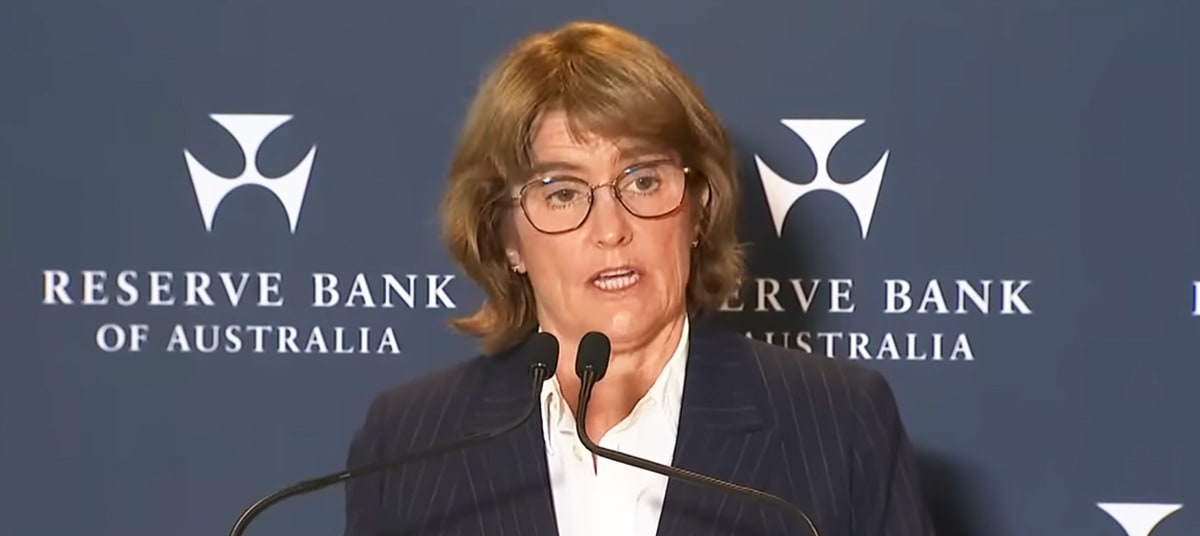
Reserve Bank of Australia governor Michele Bullock has cautioned that the ensuing conflict in the Middle East could cause inflation to remain higher for longer.
Reserve Bank of Australia (RBA) governor Bullock has warned that the latest military escalation in the Middle East could complicate already‑elevated inflation, as the central bank judges the domestic economy is running hotter than it previously anticipated.
Bullock: Demand stronger, inflation stickier
Speaking at The Australian Financial Review Business Summit in Sydney on Tuesday (3 March), Bullock said inflationary pressures had picked up again from the middle of last year and were proving more persistent than the RBA had previously assumed.
“Since the middle of last year, inflationary pressures have picked up, partly because capacity pressures have been stronger than we previously assessed,” she said.
Bullock stressed that high inflation was not an abstract concept, but rather a direct drag on households and businesses.
“High inflation imposes real costs on people and the economy. It puts pressure on household budgets, which means people need to spend more time searching for the lowest prices and working out how to make ends meet,” she said.
“High inflation also makes it harder for businesses to plan. When businesses have to spend more time managing rising costs, they have less time to plan how they can grow through investment and productivity improvements.”
The governor noted that private demand had been sturdier than anticipated, while the supply side of the economy had been weaker.
“First, private demand has been stronger than we expected. Second, the economy’s supply potential appears to have been somewhat lower than previously assessed,” she said.
Despite earlier worries that rising rates could trigger a sharp uptick in unemployment, Bullock said the labour market had remained resilient.
“Last year we were concerned that there was a risk that the labour market could weaken materially. That has not happened – which is very welcome,” she said, while acknowledging that the labour market was “somewhat tight” overall.
Expectations risk and impacts of Middle East conflict
Bullock also highlighted the risk that persistent above‑target inflation could start to shift people’s expectations, making the task of bringing it down more difficult.
“Another concern is that the longer inflation stays above target, the greater the risk that people expect inflation to stay high,” she said.
Overlaying the domestic picture is the latest military conflict in the Middle East, where US and Israeli strikes on Iran have rattled global oil markets and revived memories of past energy‑fuelled inflation spikes.
Bullock told the summit that the RBA was watching the conflict closely, but cautioned that it was too soon to draw firm conclusions about its economic impacts.
“These events are a timely reminder that in this world of geopolitical uncertainty, things can change quickly. It is too early to say what the economic impact will be, events are moving rapidly and there are different ways this can play out,” she said.
She said a supply shock, which pushed up global oil and energy prices, could “add to inflation pressures” and feed into inflation expectations.
Bullock also spoke about a prolonged hit to global activity from sustained conflict and higher energy prices, which she said could weaken growth and exert downward pressure on inflation.
“At the same time, a prolonged impact on energy markets could have adverse effects on global economic activity and result in downward pressure on inflation. It is not obvious how this might play out,” she said.
Bullock emphasised that the conflict’s potential implications for inflation were “something we are very alert to”.
CBA: Oil, petrol, and a ‘look‑through’ stance
Meanwhile, Commonwealth Bank’s economic insights team noted that the immediate economic effects from the Iran conflict were likely to be felt in financial market, sentiment, and most directly through higher oil prices.
CBA estimated that if Brent crude were to hold at around US$80 a barrel for the rest of the March quarter, fuel alone would add approximately 0.1 percentage points to its forecast for quarterly headline inflation.
The bank said this would lift its estimate of quarterly CPI to 1.2 per cent and the annual rate to 3.9 per cent.
The bank stressed that this was only the direct impact, warning that oil’s role as an input into transport, manufacturing, and logistics meant a sustained price rise could spill over into broader costs.
“There is also the potential that a higher oil price affects inflation more broadly, given its role as an input to many processes,” CBA said.
CBA also flagged a potential hit to confidence if the conflict became entrenched.
“Ongoing conflict would raise the risk of a further negative impact on sentiment and inflation expectations. Especially at a time when inflation is already too high and the Reserve Bank of Australia (RBA) has started to lift the cash rate,” the bank said.
Yet the bank said it expected the RBA to treat a modest, supply‑driven petrol shock differently from a broader demand tremor.
“We expect the RBA to look through any supply side shock to petrol and headline CPI in the near term. We continue to expect the RBA to lift the cash rate in May based on the domestic data flow,” CBA said.
CBA further cautioned that if geopolitical tensions escalated into a broad demand shock for the global economy, “the balance of risks for the RBA could shift”, potentially altering its rate plans.
[Related: Majors brace for May hike after stubborn CPI result]
Want to see more stories from trusted news sources?
Make The Adviser a preferred news source on Google.
Click here to add The Adviser as a preferred news source.