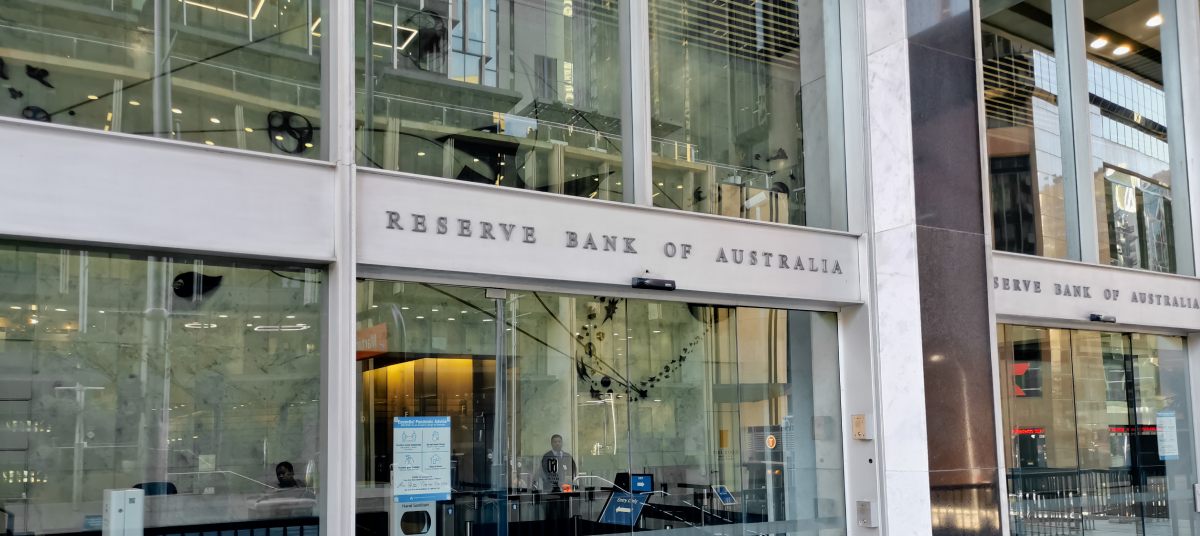
The market is generally expecting the Reserve Bank of Australia (RBA) to hold the cash rate steady today, but expectations are mounting that the next rate movement may be up.
The Monetary Policy Board of the Reserve Bank of Australia (RBA) is widely expected to keep the official cash rate steady at 3.60 per cent today (9 December).
All of the major banks have forecast that rates will continue to be on hold today for the third consecutive month in a row, holding steady the level set in August 2025 (the last time the RBA moved rates).
Similarly, the market is generally expecting rates to remain on hold today, with the ASX 30 Day Interbank Cash Rate Futures Index for December 2025 trading at 96.41 on Friday (5 December), indicating that just 3 per cent of the market expects rates to drop to 3.35 per cent.
The consensus for a rate hold largely comes due to persistent inflation pressures, a balanced (not tight) labour market, and steady GDP growth, which economists have said make the case for further easing a weak one.
Commenting ahead of the meeting, CEO of aggregation group Finsure, Simon Bednar, said: “There is absolute zero chance of a move by the RBA at this month’s meeting.
“The best news for mortgage customers next year could be the RBA keeping official rates in an extended holding pattern,” he said, but noted that there are also “headwinds into 2026” that mean it would be “questionable if we’ll see any relief in the near future”.
Indeed, Bednar said he had “concerns” that the next rate movement would be upwards.
“I have concerns there could be possibly two hikes in the New Year which is unfortunate,” Bednar said.
“This looks like it will be an important time for brokers to help their customers prepare for and navigate these challenges to get through the tough times.”
What do the lenders think?
Indeed, several lenders have been changing their rate forecasts for 2026 too, with ANZ last week becoming the third major bank to suggest that 3.60 per cent may be the terminal rate for this easing cycle.
According to Adam Boyton, ANZ’s head of Australian economics, the bank “no longer sees one final rate cut from the RBA in the first half of 2026, given recent inflation pressure”.
Further, he said that the case for further easing is also “less clear”.
Similarly, speaking on the Weekend Edition of the NAB Morning Call podcast on Friday (5 December), chief economist of National Australia Bank (NAB), Sally Auld, commented: “If the economy just was going to stay at trend growth, the foreseeable future, then maybe they [the RBA] don’t need to do anything on rates one way or the other. But economies, I guess, are sort of creatures of momentum. When they start moving in one direction, they often continue to move in that direction…
“I think they will be alert to any signs that tell them that actually the economy is picking up even more momentum as we move into 2026.”
Indeed, recent commentary from the RBA has suggested that it is uncertain as to whether the current monetary policy settings are actually restrictive. As such, concerns are rising that the next rate movement will be a rate increase, rather than a decrease.
Auld continued: “I think this is the other interesting dimension, and possibly challenging for the bank as well, which is like the longer you leave it, potentially the bigger the problem you may be dealing with.
“And so, there is an advantage in all of this, I think, in the timing to going a little bit earlier,” she said and outlined that one possibility is for the RBA to start raising rates in February 2026 if the November inflation figures (released on 7 January) land around 1 per cent.
However, AMP’s deputy chief economist, Diana Mousina, released an Econosights update on Monday (8 December), saying that talk of RBA rate hikes is “premature”.
Mousina noted that the bank believed there was greater likelihood of another rate cut than a rate hike in 2026.
She said: “ Inflation at just over 3 per cent is not a problem for the economy, there are more downside than upside risks to the economy, job ads are flat-lining, rather than accelerating, public sector spending will slow and private sector growth is not broad based.
“The consumer is more cost-conscious and sensitive to sales periods than in recent times and is unlikely to be a significant driver of economic growth in 2026.
“Interest rate hikes would risk slowing the economy given these vulnerabilities. In our view, there is a larger risk of a rate cut than a hike in 2026.”
The RBA’s Monetary Policy Board will hand down its December cash rate decision at 2:30pm AEDT.
The next rate decision will not be until 3 February 2026.
[Related: ANZ suggests it is the end of the easing cycle]
Want to see more stories from trusted news sources?
Make The Adviser a preferred news source on Google.
Click here to add The Adviser as a preferred news source.