Australia’s scams challenge is too large for any one organisation to see alone. The National Anti-Scam Centre’s 2025 report puts combined reported losses at $2.18 billion. Financial institutions are central to the response, but the critical question is what happens before funds are transferred.
Most scams begin outside an organisation’s perimeter: a malicious website, SMS, email, call, advertisement or act of social engineering can build trust and create urgency well before the fraudulent transaction. To the customer, these may feel like separate moments. To the scammer, they form one journey: build trust, direct the next step, then move money.
That is why the Scams Prevention Framework Summit in Sydney is a timely place to compare what each part of the ecosystem can see and do. A bank may see a payment or a new payee; a telecommunications provider may see a suspicious call or message; a digital platform may see an ad or account; a security provider may identify a malicious site or activity on a device. Each view is partial. Joined-up, proportionate signals can help the right organisation intervene earlier.
This does not mean sharing personal information indiscriminately. Effective collaboration depends on trusted channels, clear purposes and strong safeguards. The goal is to make relevant intelligence available to the organisation best placed to act, without losing sight of privacy, security or the customer experience.
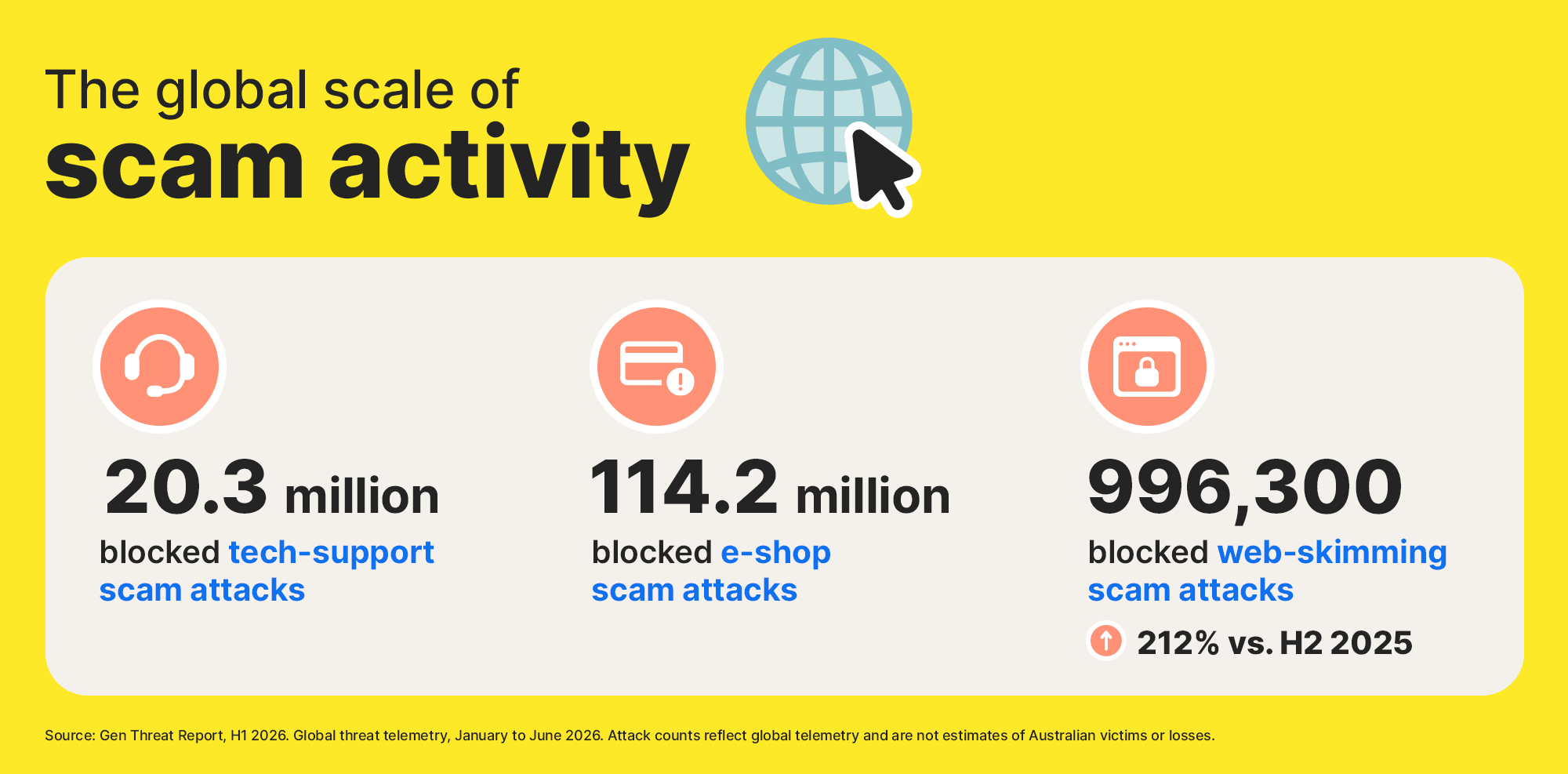
Global threat telemetry can widen that view. Gen’s H1 2026 Threat Report recorded 20.3 million blocked tech-support scam attacks and 114.2 million blocked e-shop scam attacks in the first half of the year. It also recorded 996,300 blocked web-skimming attacks, up 212 per cent on the second half of 2025. These are global, telemetry-based attack counts—not estimates of Australian victims or losses. They show how scam activity can surface across everyday digital channels, long before a bank sees a transfer.
Gen’s scam intelligence spans 50 countries and 500 million consumers across its portfolio of cybersecurity brands, including Norton, Avast, Avira, LifeLock and more. That broader footprint can help researchers see how tactics recur or evolve across markets. The point is not to assume a scam pattern travels unchanged from one country to another. It is to spot useful signals sooner, then interpret them against local behaviour, payment methods and the evidence held by Australian organisations.
As a sponsor and speaker at the Scams Prevention Framework Summit in Sydney on 18 November, Gen Digital will present From Scam Intelligence to Customer Protection: Practical Signals for the SPF Era. Drawing on the cross-market intelligence described above, the session will give organisations regulated by the SPF practical signals for prevention, detection and disruption. We will also share current data on scams targeting Australian consumers, highlighting the tactics and scale involved. For financial-services leaders, the opportunity is to turn shared intelligence into practical prevention: clearer warnings, timely disruption and support that helps customers before harm becomes harder to reverse.
Scam prevention should not be measured only by what is caught after money moves. A stronger test is whether organisations can connect the signals early enough to interrupt the path to harm while preserving customer trust. No single organisation can do that alone. The framework puts coordination in focus; better intelligence can help make it operational.