ALT TEXT: Infographic contrasting finance broking icons with currency and CFD trading icons around a central client figure.
Sooner or later a client asks the question. An SME owner watching the Aussie dollar eat into their import margins, or an investor who has been reading about gold, wants to know what you think about trading currencies or hedging with something they heard called a CFD.
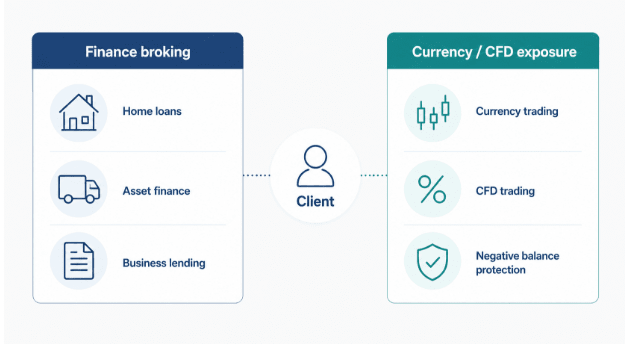
The short answer for most finance and mortgage brokers is that this sits outside your authorisation, and you should say so plainly. The longer answer is worth understanding anyway, because knowing how this corner of the market works, and how it is regulated, helps you steer the conversation responsibly and know exactly where your remit ends.
What a CFD actually is
A CFD, or contract for difference, is an agreement to exchange the difference in an asset's price between when a position opens and when it closes. You never own the underlying thing, whether that is a currency pair, gold, an index or a share. You are speculating on which way the price moves. Because these products are leveraged, a trader puts down a fraction of the position's value as margin and controls a much larger exposure, which magnifies both gains and losses.
That leverage is the whole appeal and the whole problem. A small move in the underlying price produces an outsized move in the trader's account, in either direction. For a client used to the relatively slow rhythms of property or asset finance, that speed is easy to underestimate.
Why this matters to a finance broker
You are not going to start writing CFDs. Arranging or advising on them requires a different licence, and it falls well outside the credit and finance work most brokers are authorised for. So why bother knowing any of this?
Because the questions are already landing on your desk. The Adviser's own coverage has flagged currency volatility as a live issue for brokers with import and export clients, where the timing gap between paying an overseas supplier and receiving revenue creates real exposure. When a client raises it, the value you add is not a trade recommendation. It is helping them understand that hedging currency risk for a business and speculating on currency prices are two different activities, that the second one is high risk, and that the right person for either conversation is a licensed specialist, not their mortgage broker. Knowing the landscape lets you make that hand-off with authority instead of a shrug.
How the Australian CFD landscape is regulated
Australia has some of the tighter retail CFD rules among comparable markets, and they are worth knowing in outline. Since March 2021, the Australian Securities and Investments Commission has enforced a product intervention order that reshaped what a retail client can be offered. The core protections are straightforward.
Leverage is capped by asset class. Retail clients can be offered a maximum of 30:1 on major currency pairs, with lower caps stepping down to 2:1 on crypto-assets. Negative balance protection means a retail client cannot lose more than the money in their account, even if the market gaps violently against them. And a margin close-out rule acts as a circuit breaker, forcing the provider to close losing positions once account equity falls to half the required margin.
Any legitimate operator here holds an Australian Financial Services Licence. A regulated CFD broker Australia clients might come across, such as easyMarkets, will display an AFSL number that can be checked directly on ASIC's professional registers. That check is the single most useful thing you can pass on to a curious client: if a provider cannot show a current AFS licence and an Australian entity, that is the end of the conversation.Before you trade CFDs, check the provider has an AFS licence on ASIC's Professional Registers Search.
The numbers you should quote back to a client
If a client is starry-eyed about the upside, the regulator's own data is the fastest way to ground the discussion. It is not marketing, and it is hard to argue with.
In the 2024 financial year, 68% of retail CFD investors lost money, totalling more than $458 million, including $73 million in fees. The pattern is not new. ASIC's reviews going back years have consistently found that most retail clients lose money on these products, and that the more someone trades, the more they tend to lose once fees are counted.
Regulatory scrutiny is also active rather than historical. In early 2026, ASIC secured nearly $40 million in refunds to investors after finding widespread shortcomings in how CFD issuers were distributing these products. That review covered 52 licensed issuers and flagged problems including poor client screening and misleading disclosure. The point for a broker is simple: this is a closely watched, high-risk segment, and pointing a client toward it casually is not a neutral act.
The "pro account" trap worth warning about
There is one detail that catches people out, and it is useful to know because it mirrors risk conversations you already have. Some CFD issuers offer to reclassify a retail client as a wholesale or professional client, which unlocks much higher leverage. It sounds like a promotion. It is the opposite.
Stepping up to wholesale status strips away the protections above. A wholesale client can lose more than they invest, may not have negative balance protection or margin close-out protection, and cannot get external dispute resolution through AFCA. If a client mentions they have been offered a pro or wholesale account, the responsible response is caution, not congratulation. The higher limit comes at the cost of the very safeguards that make the retail framework survivable.
Keeping it inside your lane
None of this turns you into a trading adviser, and it should not. The best-interests duty and your credit authorisation define what you can and cannot do, and CFDs sit outside that boundary for most brokers. What understanding the space does is let you be genuinely useful at the edge of your remit: you can explain what the product is, why the regulator treats it as high risk, and how to check a provider is legitimate, then refer the client to someone licensed for the actual advice. That is a better service than either pretending to know or waving the question away.
FAQs
Can a mortgage or finance broker advise clients on CFDs? Generally no. Advising on or arranging CFDs requires an Australian Financial Services Licence covering those products, which is separate from credit and finance broking authorisations. You can explain the landscape in general terms, but specific advice should come from a licensed provider.
Are CFDs the same as hedging currency risk for a business? No. Hedging is about reducing a known exposure, such as a locked-in supplier payment in another currency. Trading CFDs is speculating on price movements for profit. A client with genuine currency exposure usually needs a hedging or FX specialist, not a trading account.
How can a client check if a CFD broker is legitimate in Australia? Look up the provider's Australian Financial Services Licence number on ASIC's professional registers. If there is no current AFS licence and no Australian entity, the client should walk away. Overseas providers without an AFS licence may be scams.
What protections do retail CFD clients have in Australia? Leverage caps by asset class, negative balance protection so losses cannot exceed the account balance, and a margin close-out rule that closes positions before an account is wiped out. These apply to retail clients but not to those reclassified as wholesale.
Why does ASIC treat CFDs as high risk? Because the data shows most retail clients lose money. In FY2024, 68% lost money, and ASIC has taken repeated enforcement action over how these products are sold. Leverage magnifies losses quickly, and financing fees add up over time.
Conclusion
Currency and CFD questions are going to keep reaching brokers as clients get more exposed to global markets and more curious about trading. You do not need to become an expert, and you certainly should not start advising. What helps is knowing enough to frame the topic honestly: a CFD is a leveraged bet, Australia regulates the space through ASIC with real protections for retail clients, most of those clients still lose money, and anyone signing up should verify the provider's AFS licence first. Understanding that much lets you protect the client relationship and point people to the right specialist, which is exactly where a good broker adds value.
Want to see more stories from trusted news sources?
Make The Adviser a preferred news source on Google.
Click here to add The Adviser as a preferred news source.