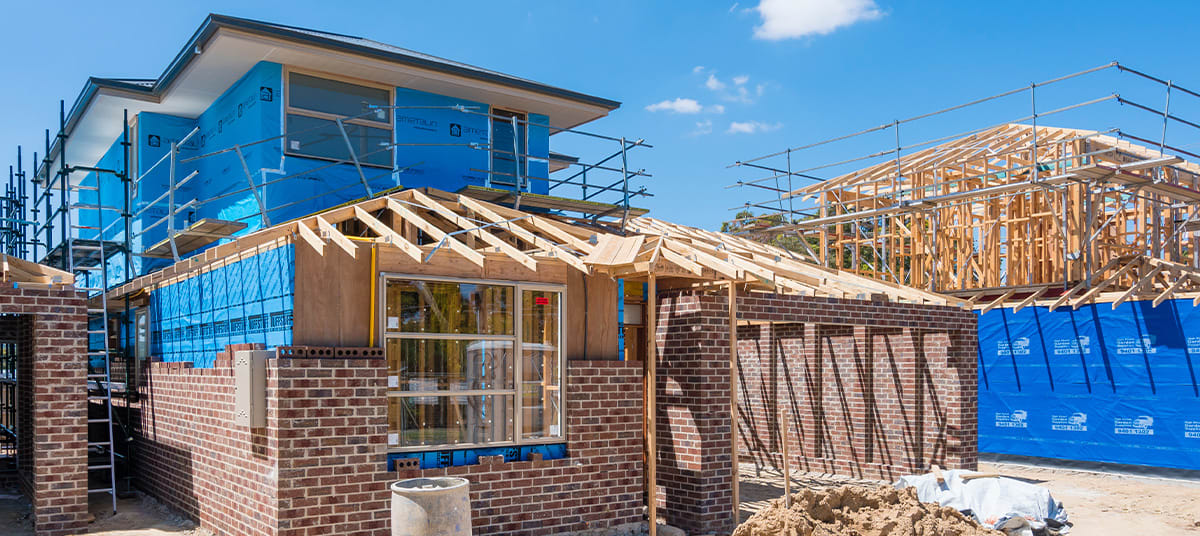
Building approvals have shown a significant rebound in new homes, but industry bodies have warned that the pipeline still trails national housing targets.
The latest Australian Bureau of Statistics (ABS) building approvals data for June 2026 have revealed that total seasonally adjusted dwelling approvals rose 7.2 per cent over the month to 18,328, leaving approvals 8.9 per cent higher than a year earlier.
Private sector house approvals inched up 0.4 per cent in June to 10,631 and are now 15.8 per cent above last year’s level, while approvals for private sector dwellings excluding houses jumped 17.8 per cent over the month to 7,138.
Apartment approvals, reported in original terms, surged 69.9 per cent in June to 4,888 dwellings, 21.9 per cent above the 12‑month average of 4,009.
Across the 2025–26 financial year, 48,778 new apartment dwellings were approved, up 13.2 per cent on the 43,079 recorded in 2024–25.
ABS highlights bigger pipeline and higher costs
The ABS emphasised that, in total, more homes are now in the approvals pipeline than in the previous year.
“In original terms, a total of 205,249 dwellings were approved to be built over 2025–26, a 9.2 per cent increase on the 187,944 approved in the previous financial year,” ABS head of construction statistics Daniel Rossi said.
Yet Rossi also noted that the nominal value attached to new house approvals continued to climb.
“The average approval value for a new house has continued to rise. During the 2025–26 financial year the average house approval was $517,430, a 5.0 per cent rise on the average of $492,931 in 2024–25,” he said.
Total dwelling approvals rose sharply in Queensland (33.4 per cent), NSW (13.2 per cent) and Western Australia (10.7 per cent), while approvals fell in Tasmania (-22.5 per cent), Victoria (-13.9 per cent) and South Australia (-11.5 per cent).
Queensland posted the largest rise in private sector house approvals, up 2.9 per cent, while South Australia’s 2.8 per cent increase took approvals to their highest level since August 2021.
Master Builders: Australia two years behind the Accord
Master Builders Australia used the June figures to measure progress against the National Housing Accord’s targets, calculating that approvals over the past financial year fell substantially short of what is needed to keep pace with supply goals.
It said the building approvals data indicated an “underbuild” of 47,750 homes over 2025–26 relative to the Accord trajectory, with 205,249 new homes approved against the 253,000 starts required to stay on track.
Master Builders chief economist Shane Garrett said the numbers reinforced a downward drift in approvals and confirmed that the sector is two years behind where it needs to be.
“The big message from today’s figures is that 47,750 fewer homes were built over the year compared with what we needed, and marks two consecutive years of Accord target shortfall,” Garrett said.
Meanwhile, Master Builders chief executive Denita Wawn said the combination of rapid price escalation and mounting compliance obligations was pushing many projects beyond viability.
“Every available housing supply lever needed to be pulled to make both renting and buying a home more affordable,” Wawn said.
“Governments must address the underlying costs of construction. Building a new home is now almost 50 per cent more expensive than it was before the pandemic, while regulatory costs are adding up to an estimated $320,000 per new house according to the Productivity Commission.”
HIA: approvals lag coming headwinds and affordability crunch
The Housing Industry Association (HIA) cautioned that June’s stronger approvals were still reflecting past market conditions rather than the latest round of economic shocks and policy changes.
“There are long lags between changes in market conditions and building approvals. The impact of rising interest rates, global conflict and tax increases are unlikely to be observed in approvals data until late this year,” HIA chief economist Tim Reardon said.
More timely indicators had already softened since the federal budget, he said.
“While leading indicators of confidence have deteriorated since the Budget, and investors are expected to withdraw from the new home building market, this won’t impact approvals for some months yet.”
At the same time, HIA sees detached housing approvals as evidence that structural demand continues to exceed available supply.
“Detached housing approvals continue to trend up, as the underlying demand for housing exceeds supply,” Reardon said.
“Nonetheless, with housing affordability at its worst levels in over 30 years, it is more important than ever that policymakers support housing investment and development by reducing the costs of home building, not increasing them.”
[Related: Auditor-General review flags housing delivery concerns]
Want to see more stories from trusted news sources?
Make The Adviser a preferred news source on Google.
Click here to add The Adviser as a preferred news source.