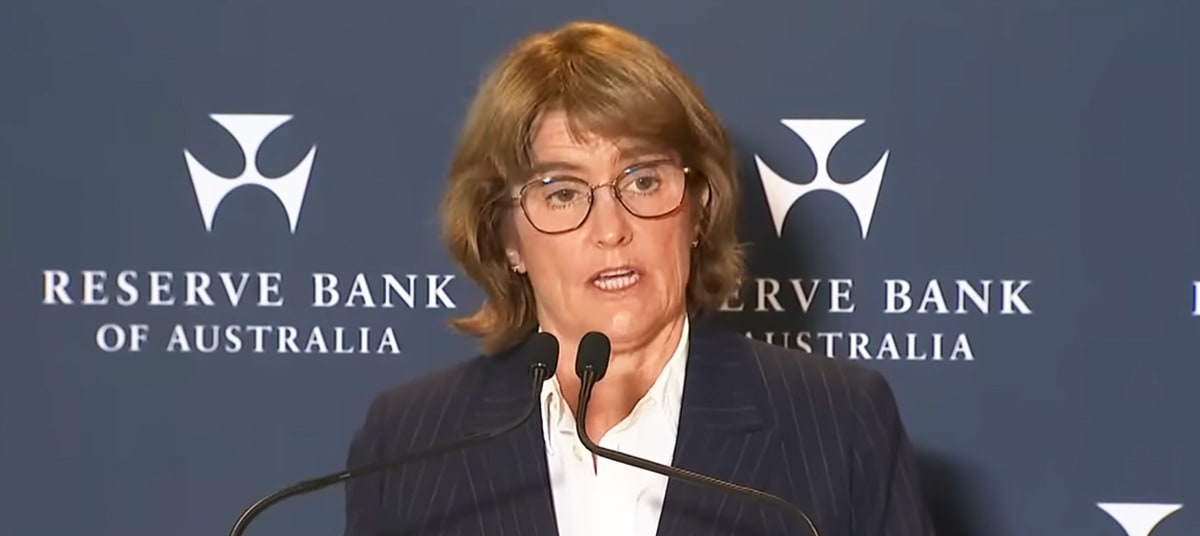
RBA governor Michele Bullock has flagged tough choices ahead on rates as sticky inflation and weak productivity squeeze the economy.
Reserve Bank of Australia (RBA) governor Michele Bullock has warned that the cash rate may need to rise again if inflation fails to return to target, using a wide‑ranging speech to deliver one of her clearest messages yet on the trade‑offs ahead.
Addressing the Anika Foundation on Tuesday (28 July) in Sydney, Bullock said the world had become more shock‑prone and that Australia’s slowdown in productivity growth was making the economy more vulnerable to those global disruptions.
In a pointed section on the cash rate outlook, Bullock made clear that the Monetary Policy Board (MPB) had not closed the door on further tightening.
“The board is prepared to act as required to achieve its mandate, including by increasing the cash rate further if needed,” Bullock said.
“If it looks like that inflation is not coming down, then I think the board have some difficult decisions to make in terms of raising interest rates.”
Bullock said that the full impact of the three rate hikes delivered earlier this year was yet to work through the economy, and that a key question for the board was whether those moves would be sufficient to suppress household spending.
She also noted that the outlook remained uncertain given rapidly changing conditions in the Middle East, with higher oil prices feeding through to broader costs.
Demand, jobs, and the cost of delay
Throughout the speech, Bullock underlined that both headline and underlying inflation – the RBA’s preferred trimmed mean measure – remained above the bank’s target and that more cooling in activity was likely to be needed.
“Overall, we continue to assess that some further easing in labour market conditions will likely be required to bring inflation back to target,” she noted.
She then linked that view to the risk of letting inflation become entrenched.
“Putting off a period of tight monetary policy today can mean higher rates and higher unemployment down the track,” she said.
“The further inflation moves from target, and the more embedded it becomes, the harder it is to reverse. Credibility is hard won and easily lost.”
Against what she described as “ongoing capacity pressures” in the economy, Bullock said the board was concentrating on preventing high-cost growth from becoming baked into prices.
“This does mean that some further easing in the growth of demand is likely to be required if we’re to bring inflation back down sustainably to target.”
Productivity and the housing downturn
Bullock devoted a substantial part of her remarks to the structural constraints created by slow productivity growth.
She explained that while the RBA could steer inflation back to target, it could not lift the economy’s underlying capacity to grow.
“While this persists, the ability of the economy to grow without generating inflation is constrained, and Australians will continue to experience limited growth in real wages,” Bullock said.
“That’s why I, personally, think getting inflation down and low and stable is critical because businesses do better in environments where they’re not worrying about cost pressures all the time,” Bullock said.
Bullock further noted that the recent downturn in Australia’s housing market had surprised the RBA.
She admitted that the central bank had expected only a modest cooling in conditions following the cash rate increases.
“We had expected conditions to ease in response to the changed outlook for monetary policy and the rise in the cash rate earlier this year. But the housing market has eased by more than we had anticipated in May.”
The sharper‑than‑expected pullback, she said, appeared to reflect a range of factors, including recent policy developments affecting the housing market, and a general softening in housing market sentiment.
[Related: RBA faces ‘challenging conundrum’ for August rate decision]
Want to see more stories from trusted news sources?
Make The Adviser a preferred news source on Google.
Click here to add The Adviser as a preferred news source.