



Australia’s mortgage market continues to evolve, with non-major banks solidifying their position as broker favourites.
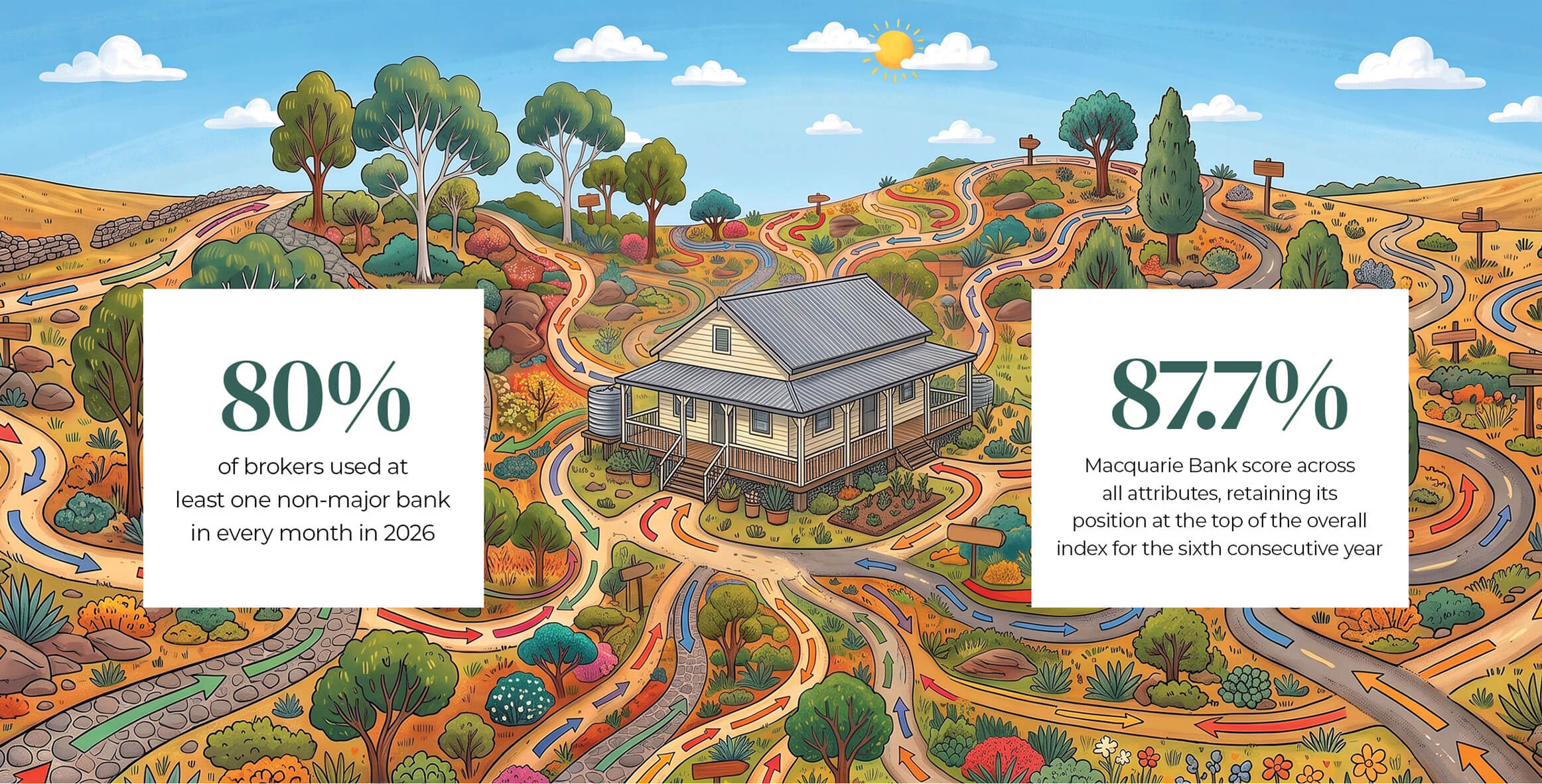
For the past year, the vast majority of brokers have sent at least one deal to a non-major bank, with Agile Market Intelligence’s monthly Broker Pulse survey revealing that more than 80 per cent of brokers used at least one non-major bank in every month in 2026.
Indeed, in July 2026, 84 per cent of brokers responding to the Broker Pulse survey said they had used at least one non-major bank – the highest proportion for any lender category.
So, what is it about the non-major banks that makes them so popular? To find out, Agile Market Intelligence conducted the latest Third-Party Lending Report 2026 to conduct a deep dive into why brokers choose the lenders they do.
It revealed that challenger brands are outperforming both the major banks and non-banks across key service metrics, setting higher standards in speed, broker support, and technology.
Conducted by Broker Pulse – the lending insights division of Agile Market Intelligence – the 17th annual survey gathered feedback from 1,261 residential, finance, and commercial mortgage brokers between 17 February and 30 April 2026.
Across the 39 institutions evaluated, non-major banks dominated the upper echelons, taking the top six spots overall.
Non-major banks led the market primarily through strong relationship management, efficient processes, and sharp product features.
This year, the top six most highly rated lenders of all 39 lenders were non-major banks:
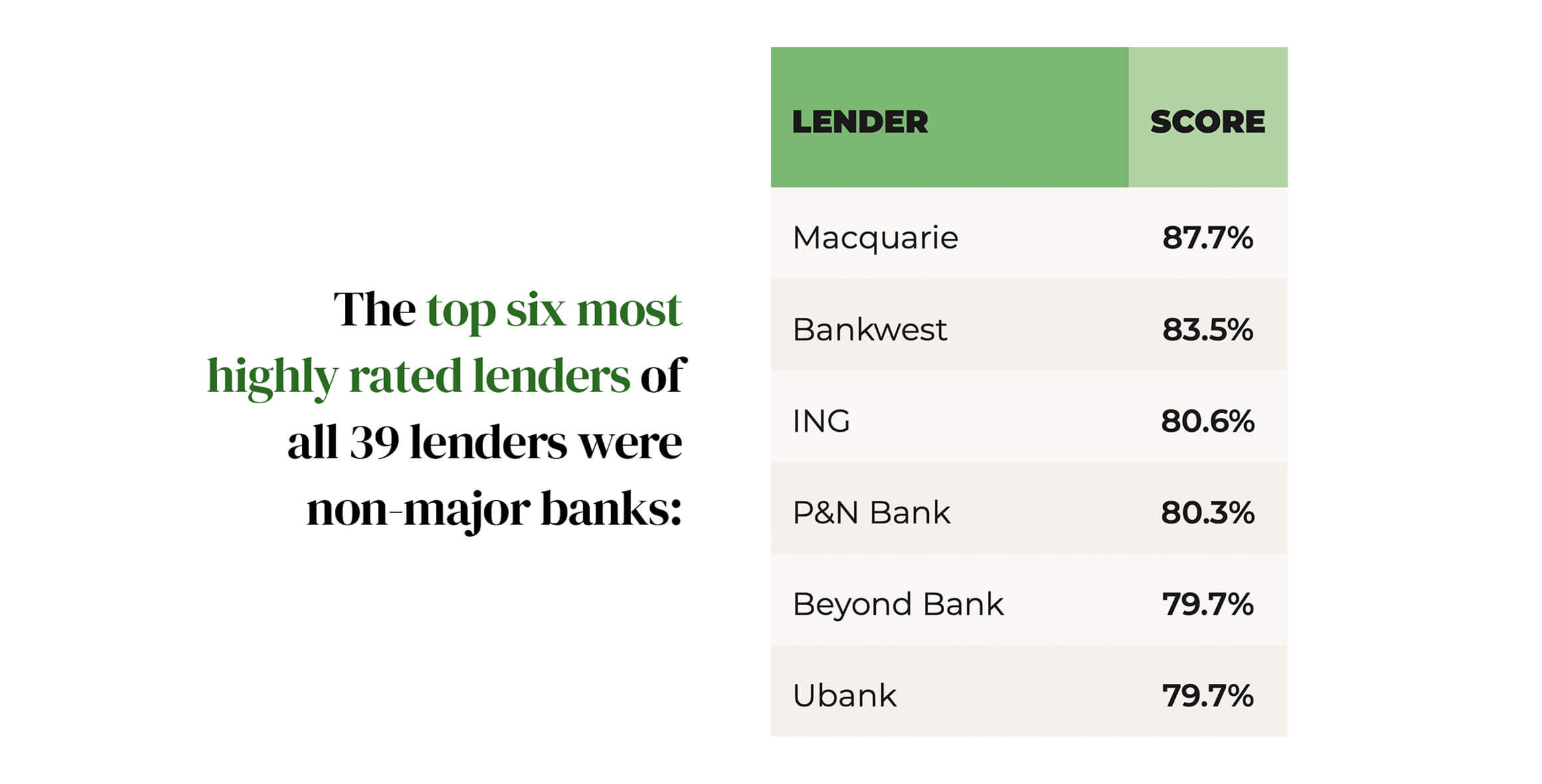
Two more rounded out the top 10: St.George Banking Group (which includes Bank of Melbourne and BankSA) was in ninth spot (79.0 per cent) and Great Southern Bank (78.8 per cent).
When excluding the mutual banks (see mutual bank ranking from August 2026 edition of The Adviser for details of how the mutual banks fared), the top five non-major banks – as rated by the broker channel – were:
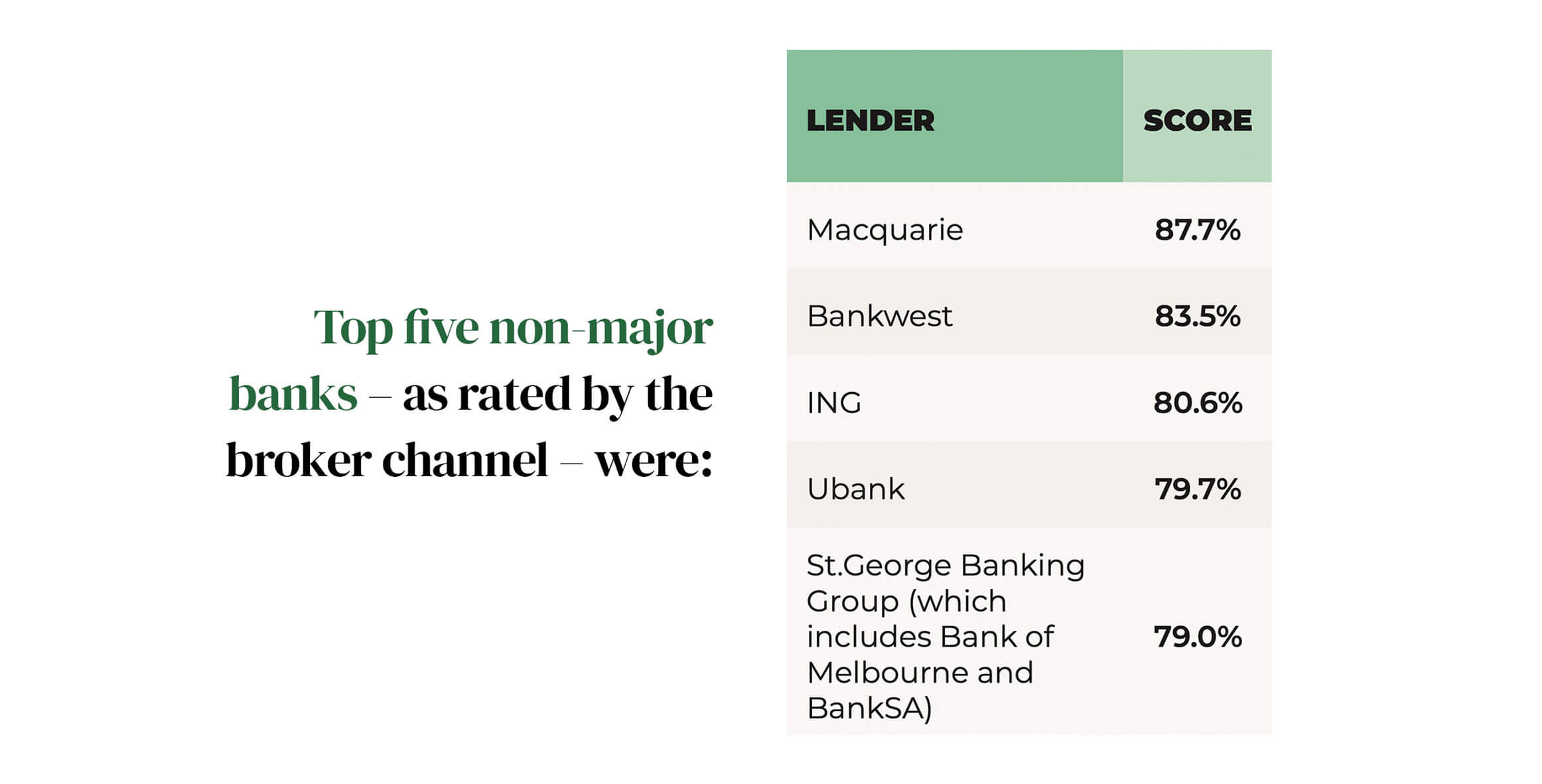
Macquarie Bank, which is increasingly closing the gap between non-major lenders and the major lenders (but is still classed as a non-major bank in this survey due to its lack of a retail branch network) retained its position at the top of the overall index for the sixth consecutive year, scoring 87.7 per cent across all attributes.
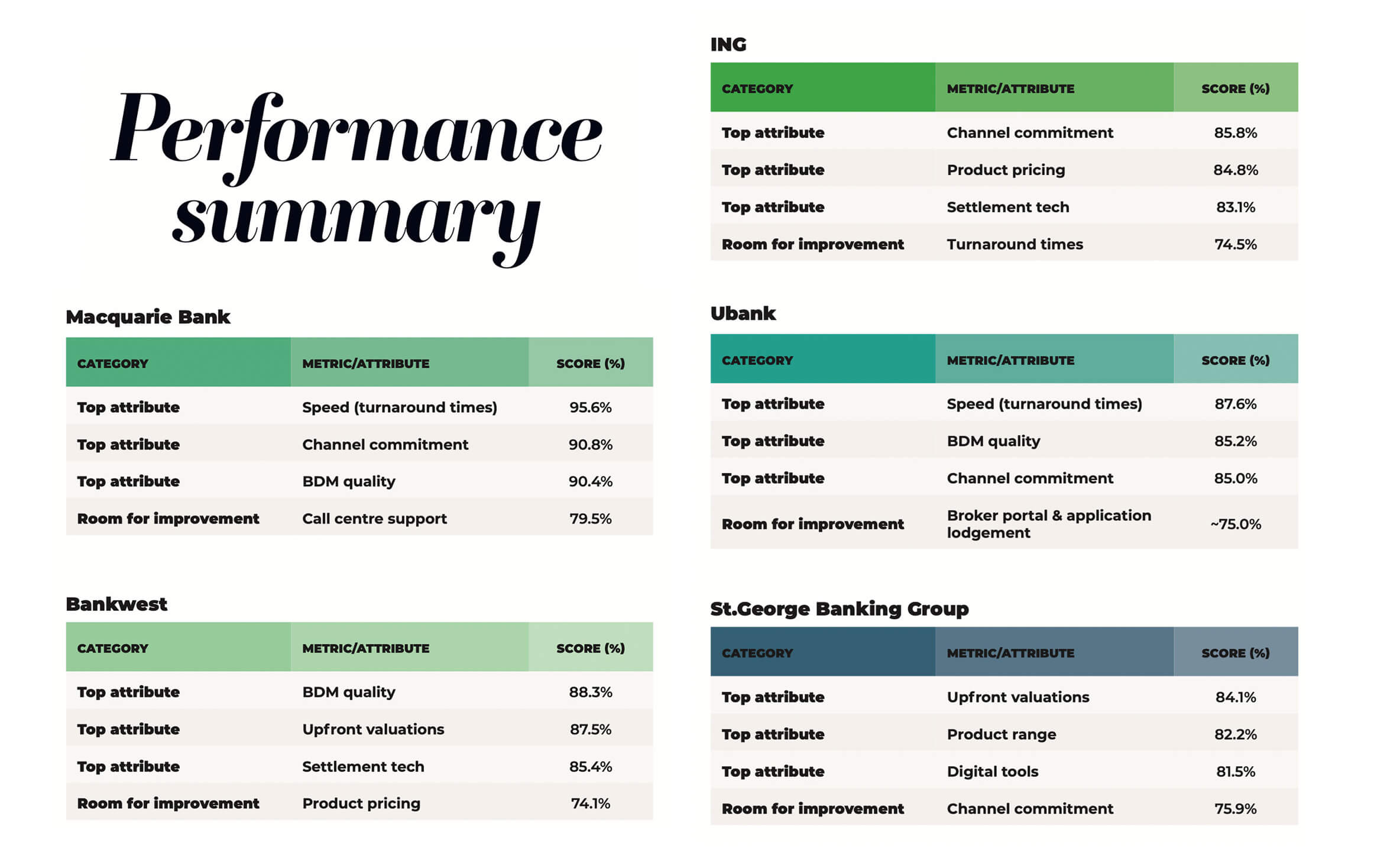
Macquarie ranked first in 14 out of 16 attributes, all landing at 83 per cent and above. Most notably, the lender scored 96 per cent for turnaround times, 91 per cent for channel commitment, and 90 per cent for BDM quality. Macquarie also topped the field in product policy, credit assessment, and document submission – a result that reflects strength across every stage of the broker experience.
Lenders like Bankwest and Ubank impressed brokers with turnaround efficiency and tech integration, while ING maintained a strong standing through sharp pricing and channel loyalty. Meanwhile, St.George Banking Group rounded out the top non-majors in ninth position overall at 79.0 per cent.
Oliver Stofka, commercial director at Agile Market Intelligence, said that sustained success in the channel requires deep operational alignment and flagged Macquarie Bank as the bank to emulate: “Six consecutive years at the top of this report is a result that goes beyond having a strong product or a fast turnaround. It reflects an organisation that has made a structural commitment to the broker channel and held to it”, and noted Macquarie’s ongoing dominance.
Stofka highlighted that performance in foundational areas builds long-term broker confidence: “A 95.6 per cent turnaround time score tells you brokers trust Macquarie to move when it matters. Leading in product policy and credit assessment tells you they trust it to get the answer right. That combination is what puts Macquarie in a category of its own.”
Mutual banks and smaller institutions listed in the non-major cohort also delivered standout performances in personnel and support. Details regarding mutual banks from the survey – including P&N Bank, Beyond Bank, Great Southern Bank, and Bank Australia – can be found in the August 2026 edition of The Adviser via the Mutual attraction cover story.
2026 marks P&N’s second consecutive year leading the mutual bank cohort and the first time the lender has topped the small non-major banks. Having climbed from 59 per cent in 2021 to 80 per cent in 2026, the improvement represents the steepest five-year rise in the cohort, driven by sustained investment in personnel, support, and credit.
Stofka said: “Two consecutive years leading the mutual bank cohort already spoke to consistency. Topping the small non-major banks for the first time signals progression in the areas brokers care most about, communication, credit, support, and the quality of its people.”
Topping the small non-major banks for the first time signals progression in the areas brokers care most about, communication, credit, support, and the quality of its people.
The methodology
Now in its 17th year, the annual Third-Party Lending Report by Broker Pulse tracks lender performance to highlight broader mortgage industry trends and shifting market dynamics.
The 2026 survey was conducted online between 17 February and 30 April 2026, inviting finance and mortgage brokers nationwide to evaluate the lenders they actively used over the prior 12 months.
A total of 1,261 residential, commercial, and finance brokers participated. Following data validation to filter duplicate or incomplete entries, the final dataset reflects active broker sentiment across 39 lending institutions. Final rankings are established based on each lender’s total score, representing the arithmetic average across all 16 rated performance attributes.
Get the full report
This year's full Third-Party Lending Report can be acquired from Broker Pulse by Agile Market Intelligence here.
The 16 attributes brokers were asked to rate:
Personnel
- BDMs: Quality, accessibility, proactivity, and issue resolution capabilities of BDMs.
- Call centre support: Technical knowledge, responsiveness, and service efficiency of call staff.
- Credit assessment staff: Accessibility, ease of communication, and consistency of credit decisions.
Products
- Product policy: Clarity and breadth of lending policies across key market segments.
- Product pricing: Competitiveness of interest rates, fees, and overall pricing structures.
- Product range: Depth and suitability of mortgage products available.
Speed
- Turnaround times: End-to-end processing speed across submission, approval, documentation, and funding.
Support
- Broker communication and training: Clarity and frequency of updates regarding policy, pricing, and operational changes.
- Channel commitment: Dedication to the third-party channel while avoiding channel conflict.
- Settlement: Timeliness and operational simplicity during the settlement process.
- Post-settlement support: Ongoing servicing quality for clients after loan completion.
Technology
- Application lodgement: Overall online platform functionality, stability, and submission flow.
- Broker portal: Ease of navigation, information accessibility, and overall portal usability.
- Digital tools: Availability of digital integration tools including VOI and e-signatures.
- Document submission: Streamlined processing and lower documentation friction.
- Upfront valuations: Accuracy, speed, and reliability of valuation ordering platforms.