



As the third-party channel anchors itself deeper than ever into Australia’s mortgage market, the major banks find themselves at a critical junction – forced to fortify their foundations to meet escalating broker expectations.
But what structural elements do brokers value most in their lender partners? And how do the four pillars measure up? To find out, Broker Pulse – the lending insights division of Agile Market Intelligence – surveyed the broker channel for its annual Third-Party Lending Report.
Now in its 17th year, the annual survey asks mortgage and finance brokers to rate the structural performance of the residential mortgage lenders they have built relationships with over the last 12 months. The report continues to be the clear industry benchmark by which lenders evaluate the strength of their third-party channel offering, enabling them to map out broker support across their proposition and track changes year on year.
The data reinforces a growing demand for a well-rounded architectural framework that balances flexible product mechanics with flawless process efficiency.
Pillar of strength
While the four major banks (Australia and New Zealand Bank [ANZ], Commonwealth Bank of Australia [CBA], National Australia Bank [NAB], and Westpac Banking Corporation [Westpac]) may be known as the ‘four pillars’ in lending, they aren’t top picks when it comes to broker experiences.
According to the 2026 Third-Party Lending Report, none of the major banks made it into the top 10 lenders based on broker experience. In fact, the highest-rated major bank was the 13th lender in the ranking in 2026, with a score of just over 78 per cent – a full 10 percentage points lower than the top-rated lender (Macquarie Bank). Even when only considering just the largest lenders (those used by more than 20 per cent of broker respondents), the highest-ranked major bank (Westpac) was in seventh place.
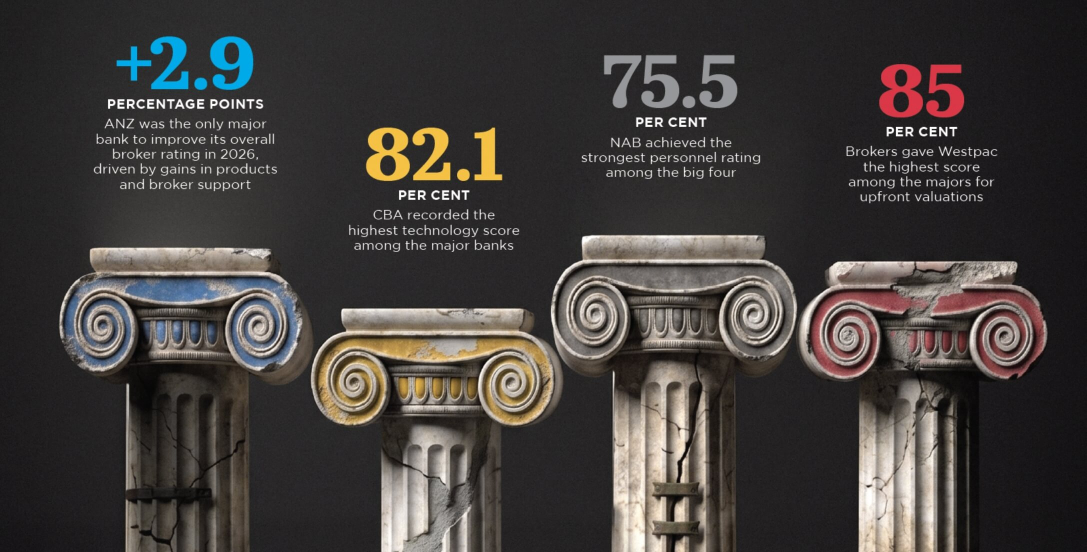
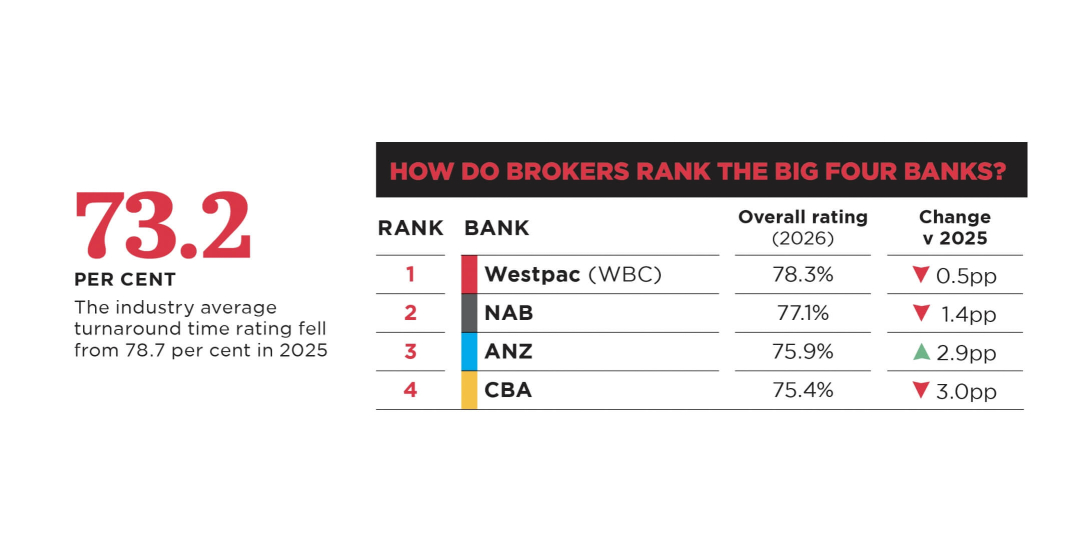
Westpac appears to have engineered the sturdiest framework among the big four, with the highest overall broker rating of all major banks – at 78.3 per cent. As such, it held its ground as the leading major bank when it comes to broker experience for the second year in a row.
The bank is said to be robust in products (80. 0 per cent) and technology (80. 8 per cent), with brokers loving the bank’s upfront valuations, in particular.
Agile Market Intelligence’s commercial director, Oliver Stofka, said: “Westpac’s lead in the major bank cohort is built on attributes that brokers encounter at the most consequential moments of a transaction. Topping the group in upfront valuations speaks to one of the more under-appreciated parts of the broker experience, the ability to give clients an accurate picture of value before the process goes too far. That kind of transparency builds confidence on both sides of the table.
Westpac’s lead in the major bank cohort is built on attributes that brokers encounter at the most consequential moments of a transaction
– Oliver Stofka, commercial director, Agile Market Intelligence
“Combined with leading in product range, Westpac can accommodate a wider cross-section of client needs without brokers having to look elsewhere.”
2026 marks Westpac’s second consecutive year leading the major bank cohort. Having moved from mid-table rankings to the top of the group, the improvement in ‘support’ attributes has been particularly notable, the hardest category to move quickly, and the one brokers feel most acutely when a transaction is under pressure.
Stofka said: “Moving from mid-table to the top of the cohort over recent years, with particular improvement in support, points to a lender that has done more than refine its product offering. It has rethought how it shows up for brokers.” Nevertheless, Westpac’s overall score is still down on the 79 per cent recorded in 2025.
In fact, three of the four majors saw their overall broker scores fall this year, with ANZ being the only major pillar to demonstrate positive structural growth year on year, lifting its overall score by +2. 9 percentage points, reinforced by substantial gains in products (+3. 4pp) and support (+2. 4pp).
Conversely, CBA’s framework suffered the heaviest blow, sliding 3.0 percentage points to sit at the bottom of the major bank foundation.
Cracks in the framework
The shifts come as brokers closely inspect the stability of each major bank’s proposition amid shifting performance metrics. The most alarming structural shift in 2026 is that processing speed declined significantly across all four pillars. This aligns with a market-wide slowdown, where the industry average for turnaround times fell from 78.7 per cent to 73.2 per cent.
NAB’s operational pipeline felt the greatest strain, with its speed rating dropping sharply from 84.1 per cent down to 73.3 per cent.
Furthermore, personnel remain a hollow spot for all big four institutions when compared to the broader market. All four pillars scored below the market average of 76.5 per cent for its personnel (BDMs and credit staff) in 2026, with CBA and ANZ lagging furthest behind at approximately 70 per cent and 71 per cent.
While the major banks continue to leverage massive technology platforms as the scaffolding for their digital offerings, they face persistent structural challenges in personnel and channel loyalty across the 39 lenders evaluated in the survey.
Given that brokers write more than 81 per cent of all residential mortgages in Australia – a new record share – their collective sentiment and referral workflows will continue to dictate how mortgage volumes shift.
For the four pillars, future growth relies entirely on their ability to patch up glaring vulnerabilities, resolve internal channel conflict, and build an unbreakable bridge to the broker community.
The methodology
Now in its 17th year of publication, the Third-Party Lending Report helps track lender performance over time to map out industry trends and changes in the competitive landscape.
The survey for the 2026 Third-Party Lending Report was conducted by Agile Market Intelligence between 17 February and 30 April 2026. The survey encouraged mortgage and finance brokers across Australia to participate in a self-assessed evaluation of lender performance from their experiences over the last 12 months. Participants were invited to complete this survey by email through The Adviser, Broker Daily, and Broker Pulse’s broker panel.
This year, 1,261 residential, finance, and commercial mortgage brokers completed the survey, providing a wide variety of views and experiences to paint a holistic picture of all 39 lenders in the marketplace.
The 16 attributes brokers were asked to rate banks on:
Personnel
1. BDMs: Overall quality of BDMs including access to BDMs, BDM proactivity, and effectiveness in solving queries or challenges.
2. Call centre support: Overall service quality, including staff technical knowledge, responsiveness, and helpfulness.
3. Credit assessment staff: Access to and ease in dealing/communicating with credit assessment staff including their consistency of credit decisions.
Products
4. Product policy: Consider the clarity of product policies across key market segments.
5. Product pricing: Consider the competitiveness of pricing, interest rates, and fees across key market segments.
6. Product range: Consider the availability and depth of products available to suit key market segments.
Speed
7. Turnaround times: Overall end-to-end turnaround speed including application processing, loan approval, contract, and funding timeliness.
Support
8. Broker communication and training: Effectiveness of communication and education with brokers (verbal, written, or otherwise) when dealing with queries, processes, product pricing, policy changes, or servicing times
9. Channel commitment: Consider the lender’s ongoing commitment and loyalty to the broker channel.
10. Settlement: Settlement timeliness, ease of understanding documents.
11. Post-settlement support: Effectiveness in servicing clients post-settlement.
Technology
12. Application lodgement: Online application platform experience.
13. Broker portal: Effectiveness and functionality of the broker portal.
14. Digital tools: Access to digital tools including e-signature and VOI.
15. Document submission: Volume and ease of submitting documents.
16. Upfront valuations: Availability and effectiveness of valuation ordering.