




Offer a broker an extra 10 hours a week to focus on tasks they’ve been meaning to get to, and odds are they’d take it without hesitation.
Most brokers have a lot on their plates, and some of the most time-intensive work and decision making that sits with the broker, including document collection and verification demands care and attention every time.
So how can brokers free up time for more client-facing work and big-picture thinking?
Adam Brown, executive for broker distribution at National Australia Bank (NAB), says digital tools, automation, and artificial intelligence (AI) are already making a difference, but their value depends on how they are applied.
“As AI and digital tools become more embedded in lending and business operations, it’s critical that brokers are equipped with the right guardrails,” he says.
“At NAB, we’re committed to providing brokers with practical tools, education and resources that help reduce scam risk, protect sensitive client information and reinforce trust – which remains central to successful broker customer relationships.”
When implemented effectively, these technologies can deliver meaningful efficiency gains, giving brokers more time to focus on building strong relationships with their customers.
“In practice, this means less time spent on repetitive administrative tasks and more time focused on guiding customers through complex financial decisions and helping them realise their goals,” he says.
Further efficiencies can be gained through technology and artificial intelligence (AI).
“As lending conditions and customer needs become more nuanced, AI can help brokers surface insights more quickly, respond faster and run more scalable, resilient businesses behind the scenes,” Brown says.
AI can help brokers surface insights more quickly, respond faster and run more scalable, resilient businesses behind the scenes
– Adam Brown, executive for broker distribution, NAB
According to NAB’s executive for broker distribution, many of Australia’s small- to medium-sized enterprises (SMEs) – including brokerages – are already embracing these tools, with around 45 per cent of them saving 12 hours a month of management time through AI process automation.
“AI is increasingly being used to simplify and speed up core parts of the lending process, from document handling and categorisation, through to application workflows,” he adds.
“Importantly, brokers retain full responsibility for document verification and final decisions, with AI used to support efficiency rather than replace professional judgement.
“This is helping brokers keep pace with growing customers’ expectations around speed and responsiveness, while creating more capacity to focus on guidance and support, particularly in more complex lending scenarios.”
Smarter and more strategic
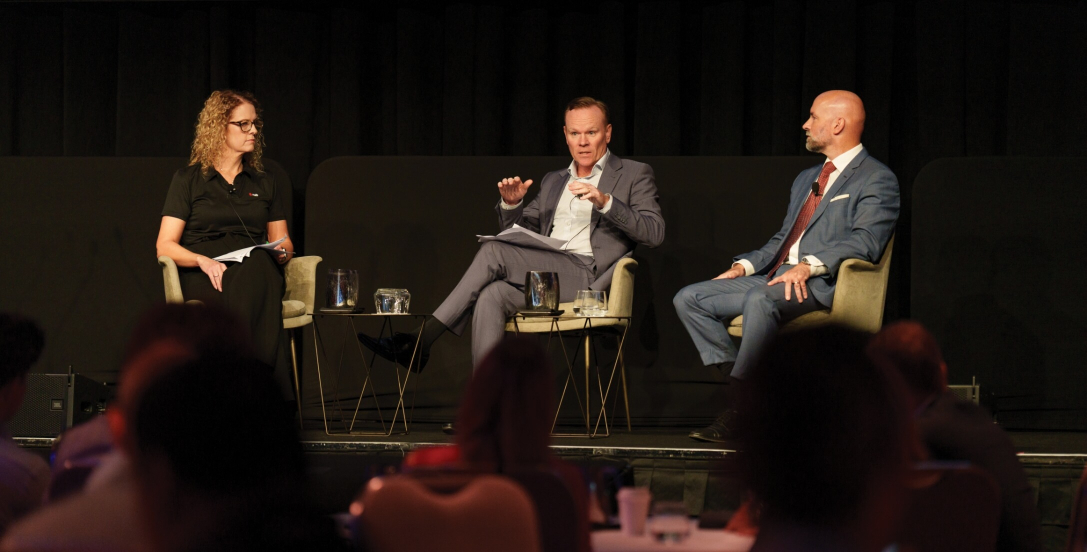
Finding efficiencies with AI tools was one of the big talking points at the Better Business Summit 2026, run in partnership with NAB, where AI and marketing coach Adam Franklin shared tips to help brokers manage recurring tasks and streamline admin.
Franklin, who regularly trains advisers, accountants, and agents, says there is a range of file-based broker tasks that can be automated or simplified.
He suggests brokers adopt a ‘master prompt framework’ for the AI tools – a statement of intent shared with the AI’s personalisation settings to inform its work and standardise repetitive work.
At the summit, for example, Franklin shared the ins and outs of how to set up five prompts, including those to summarise fact finds and needs and objectives from meeting notes, create post-discovery client communications, provide best interests duty evidence summaries, condense lender/policy updates for borrowers, and systemise settlement and post-settlement email trails.
“Once you’ve done this, every conversation, chat and project is operating within the guardrails. You’ve got a prompt for every task in the business, every marketing asset and every client communication is through the lens of you and your business,” he adds.
“At that point, it very much goes from being generic AI to being genuinely yours.
“It’s getting those tasks done with a primary goal to free up capacity and time.
“Once you’ve got those hours back in your calendar, you’re free to use them to do the client-facing, relationship-based, high-value work that not only you enjoy more, but clients value more and is also more profitable for you. That’s where I want to see brokers spending more time.”
When discussing how this might look, Franklin outlines best-practice AI use through what he calls the 10/80/10 or ‘wedding cake’ principle.
“The first 10 per cent is up to you as the broker or the business. You decide the concept, you decide the constraints, and then AI can do the messy middle. AI can do all that grunt work,” he says.
“But then the final 10 per cent is the icing on the cake. So, this is where you sprinkle your own personal magic. And, most importantly, you take responsibility for what the AI has said/created. It’s still your responsibility to verify everything that’s said.
“You need guardrails. Before anything that AI has produced sees a client or sees the light of day, please verify it yourself because you are the one responsible.”

Best practice for brokers
As with any new technology, the advancement of AI brings risks.
Brown notes that while AI is driving efficiency and productivity gains, increasingly sophisticated systems also have the potential to be exploited by criminals.
“While AI is driving efficiency and productivity gains, increasingly sophisticated technology is also being exploited by criminals,” he says.
“As automation and digital tools become more embedded in business operations, cyber crime and scams continue to evolve rapidly, posing a growing risk to small businesses and brokers alike. New data from the Australian Bureau of Statistics (ABS) shows that one in seven Australians has experienced personal fraud, underscoring the scale of the challenge.”
As Brown explains, the risks are not purely financial.
“It goes to the heart of client trust and business continuity. Sensitive client loan information, business systems and staff details are all potential targets,” he says.
“Common threats include phishing scams, invoice fraud and remote access scams, often designed to create urgency or panic and trick victims into acting quickly.
“Understanding these risks and recognising early warning signs is critical to protecting both your business and customers. Red flags can include urgent payment requests, unexpected changes to account details, unusual login activity or messages claiming an account is at risk.”
How to protect your business
Brown says brokers can do a number of things, such as proactively helping customers understand how to recognise and avoid scams.
“Protecting your business also means protecting customers,” he adds.
“Simple steps such as educating staff, strengthening passwords, checking email settings, using multi-factor authentication and fostering a strong cyber-aware culture can make a significant difference.”
Franklin also reiterates the importance of broker responsibility with sensitive information.
“The responsibility sits with you as the broker. I would always anonymise all the documents and spreadsheets that you upload. It’s best practice,” he says.
“It’s also good practice in the guardrails to specifically say, ‘Treat everything as confidential’ or ‘Don’t reference it later’. The AI doesn’t have a licence. You have a licence.
“So best practice would be to make it anonymous rather than risk anything.”
While cyber threats aren’t going away, Brown says staying informed and adopting strong security practices can help brokers stay one step ahead. NAB continues to invest in scam prevention and broker education to support brokers to operate securely and with confidence, for both their businesses and customers.
“NAB’s Business Security Hub provides practical tools, checklists and insights to help brokers recognise emerging scams, strengthen their defences and support customers – reinforcing trust and protecting business reputations,” Brown concludes.