


As the third-party channel anchors itself deeper than ever into Australia’s mortgage market, mutual banks find themselves at a crucial crossroads to balance exceptional personalised service with operational scaling pressures.
But what structural elements do brokers value most in their customer-owned lender partners? And how do the mutual banks measure up? To find out, Broker Pulse – the lending insights division of Agile Market Intelligence – surveyed the broker channel for its annual Third-Party Lending Report.
Now in its 17th year of publication, the annual self-assessed survey asks mortgage and finance brokers across Australia to evaluate the lender performance of residential mortgage lenders they have built relationships with over the last 12 months.
The findings highlight a distinct pattern across customer-owned institutions: while brokers enjoy the support available, they are frustrated by below-market average turnaround times, which fall below the market average of 73.11 per cent.
An attractive proposition
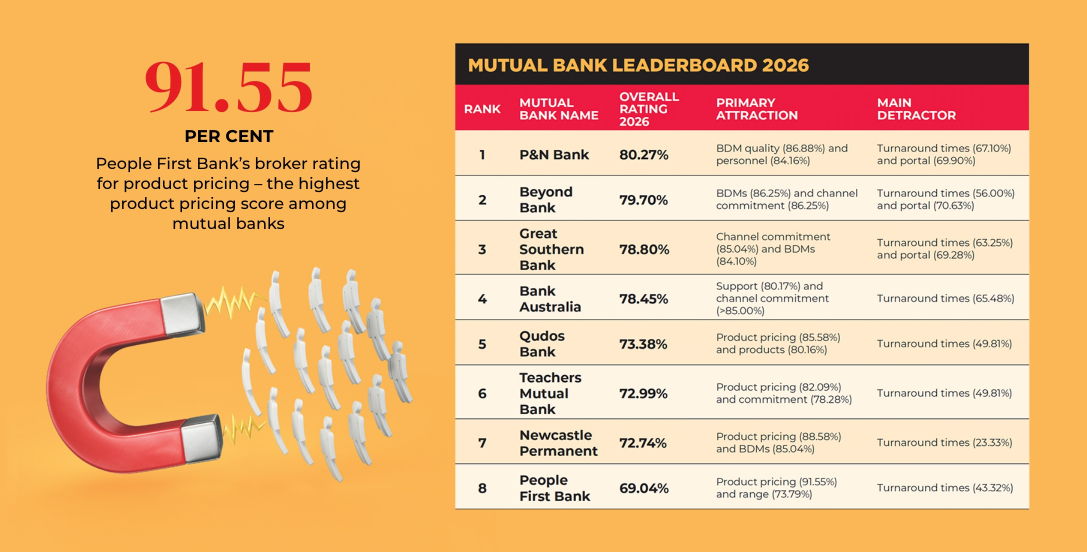
Unlike the major banks (see the July 2026 edition for more), mutual banks secured a strong presence among Australia’s highest-rated lenders. According to this year’s Third-Party Lending Report, P&N Bank had the fourth-highest rating of all 39 lenders (albeit based on feedback from fewer than 20 per cent of broker respondents), with an overall score of 80 per cent – coming in just behind ING Australia (81 per cent).
Another mutual lender, Beyond Bank, came in as the fifth-highest-rated lender by broker experience, according to the report, with a score of 80 per cent.
Bank Australia also scored well with 78 per cent, while Great Southern Bank (GSB) came in with a score of 79 per cent. In fact, GSB was the only mutual bank to place in the top 10 of the larger bank category (used by more than 20 per cent of broker respondents) and was the sixth-highest-rated large bank in the report.
Looking at individual lender feedback in the Third-Party Lending Report, it’s clear there are common themes attracting and repelling brokers to and from customer-owned lenders.
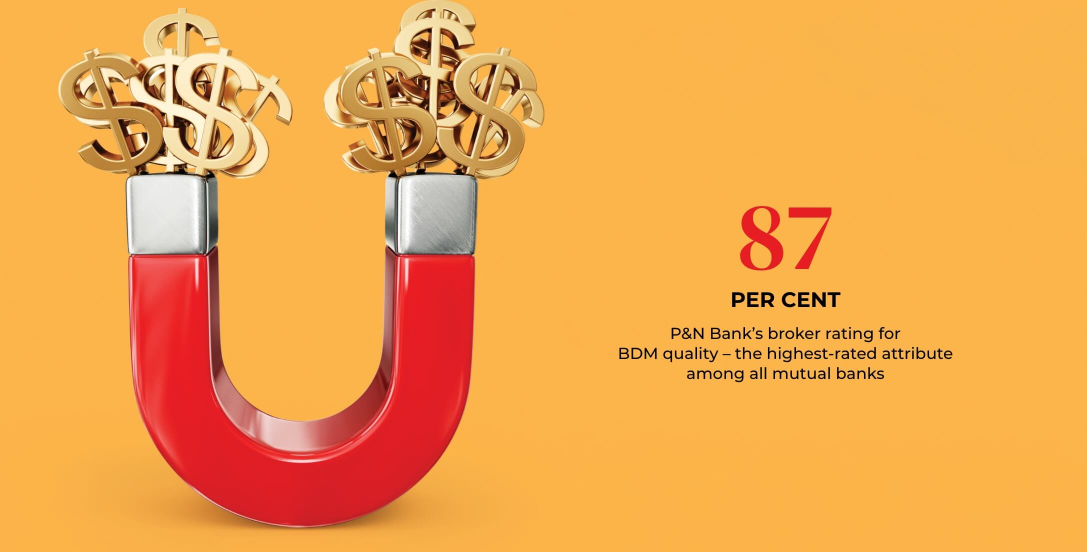
Brokers are enjoying the strong support available, notably high ratings for business development managers, product pricing, and channel commitment, but are frustrated by lagging turnaround times across the board.
But much is happening in the mutual banking space. Australia’s customer-owned sector is undergoing significant consolidation – as it has been for the past few years. Several major deals were finalised in the financial year 2026, including Teachers Mutual Bank combining with Australian Mutual Bank on 1 May, Family First Bank fully integrating under Beyond Bank on 7 June, and Summerland Bank merging with Regional Australia Bank (targeting mid-2026 completion to manage over $5 billion).
Meanwhile, Bank Australia and P&N Group signed an MOU in May to explore building a national customer-owned bank, while Hume Bank and Geelong Bank cleared early APRA hurdles to prepare member votes.
This ongoing integration is also altering survey visibility. Qudos Bank, which merged with Bank Australia on 1 July 2025, placed 30th overall (73.38 per cent). Its brand will be mothballed in 2027 as operations fully transition to Bank Australia, leveraging its superior platform, reach, and growth potential.
As brokers write a record share of residential mortgages, lender evaluations and referral workflows will continue to determine how mortgage volumes shift across third-party propositions.
The shifts come as brokers closely inspect the stability of each major bank’s proposition amid shifting performance metrics. The most alarming structural shift in 2026 is that processing speed declined significantly across all four pillars. This aligns with a market-wide slowdown, where the industry average for turnaround times fell from 78.7 per cent to 73.2 per cent.
NAB’s operational pipeline felt the greatest strain, with its speed rating dropping sharply from 84.1 per cent down to 73.3 per cent.
Furthermore, personnel remain a hollow spot for all big four institutions when compared to the broader market. All four pillars scored below the market average of 76.5 per cent for its personnel (BDMs and credit staff) in 2026, with CBA and ANZ lagging furthest behind at approximately 70 per cent and 71 per cent.
While the major banks continue to leverage massive technology platforms as the scaffolding for their digital offerings, they face persistent structural challenges in personnel and channel loyalty across the 39 lenders evaluated in the survey.
Given that brokers write more than 81 per cent of all residential mortgages in Australia – a new record share – their collective sentiment and referral workflows will continue to dictate how mortgage volumes shift.
For the four pillars, future growth relies entirely on their ability to patch up glaring vulnerabilities, resolve internal channel conflict, and build an unbreakable bridge to the broker community.
The methodology
Now in its 17th year of publication, the Third-Party Lending Report helps track lender performance over time to map out industry trends and changes in the competitive landscape.
The survey for this year’s report was conducted by Agile Market Intelligence between 17 February and 30 April 2026.
The survey encouraged mortgage and fi nance brokers across Australia to participate in a self-assessed evaluation of lender performance from their experiences over the last 12 months. Participants were invited to complete this survey by email through The Adviser, Broker Daily, and Broker Pulse’s broker panel.
This year, 1,261 residential, fi nance, and commercial mortgage brokers completed the survey, providing a wide variety of views and experiences to paint a holistic picture of all 39 lenders in the marketplace.
How do the majors stack up?
Read our July 2026 edition for the full analysis of the largest lenders.