


It’s been a transformative few years for the customer-owned banking community, with the rate of consolidation seemingly picking up over the past few months.
Ever since the prudential regulator said in 2020 that it would be “prudent” for smaller customer-owned banks to merge, so they could better afford technology and cyber resilience, support investment growth, and scale, there has been a smorgasbord of mergers and acquisitions in the mutual banking space.
Currently, there are around 50 mutual banks, but this number is expected to dwindle further as more consolidation takes place.
In fact, this month alone will see several mergers take place.
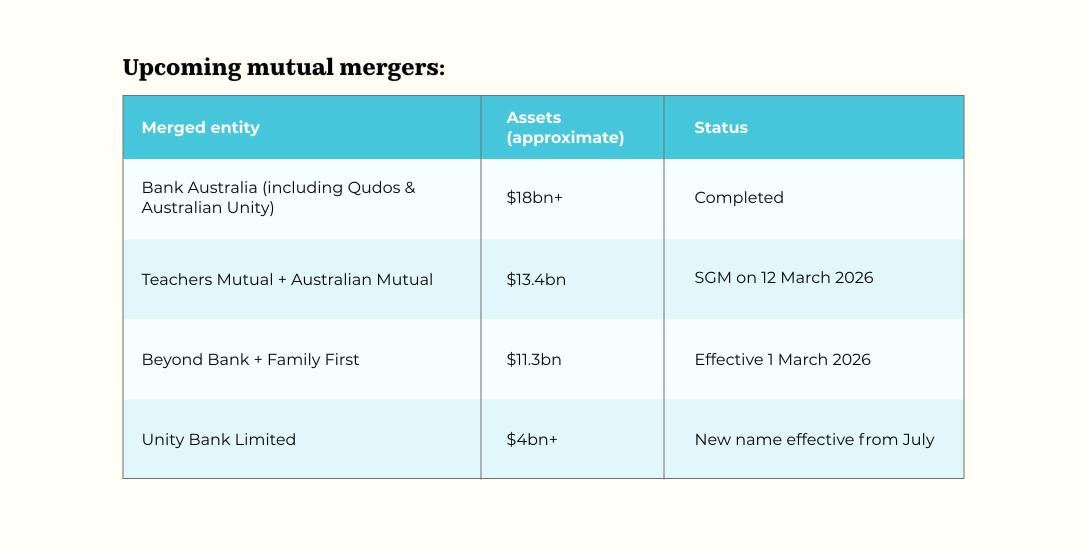
Family First Bank is set to officially merge with Beyond Bank Australia on 1 March 2026, following a landslide 89.6 per cent “yes” vote from members in late January. The merger extends Beyond Bank’s reach deep into regional NSW hubs, including Lithgow, Bathurst, and Mudgee, creating a combined group managing more than $11.3 billion in assets.
This month will also see the proposed merger between Teachers Mutual Bank Limited (TMBL) and Australian Mutual Bank come to a head. While the boards endorsed the merger last year, members are currently still voting on the proposed move, which would create a $13.4 billion entity serving 280,000 members across 13 branches in ACT, NSW, Victoria, and Western Australia.
A special general meeting (SGM) of TMBL members has been set for Thursday, 12 March 2026, with the expectation that members will resoundingly vote in favour, particularly given the merged entity will continue to be 100 per cent owned by its members.
“This merger is a strategic decision that will make us even stronger and better equipped to meet the challenges ahead, while holding true to our purpose and our history,” Anthony Hughes, CEO of Teachers Mutual Bank Limited, said.
Other mutual mergers taking place this year include the marriage of Summerland Bank and Regional Australia Bank. More than 96 per cent of both Summerland Bank’s members and Regional Australia Bank’s members voted in favour of merging in November last year, with the path cleared for the two to consolidate from 1 July 2026.
The combined entity will manage more than $5 billion in assets, servicing more than 130,000 members across 49 locations in regional NSW and southern Queensland.
All lenders have said they will continue to work closely with the broker channel for home loan distribution.
The activity taking place this year builds on a massive year of structural change. Last year, several mergers would finalised, including:
Bank Australia’s acquisition of Qudos Bank in July and Australian Unity Bank in November 2025, creating a customer-owned bank holding nearly $17.5 billion in assets and almost 900 employees.
G&C Mutual Bank and Unity Bank finalised their merger in March 2025, with the merged entity moving to the new name of Unity Bank Limited in July.
But not all merger attempts have been successful. In late January, Police & Nurses Limited (PNL) – the group behind P&N Bank and BCU Bank – confirmed that merger discussions with Great Southern Bank (GSB) had been terminated. Both boards concluded that the deal, which would have created a $30 billion entity, was “not in the best interests of customers”.
This marked PNL’s second unsuccessful attempt in two years, following a failed tie-up with Beyond Bank in late 2024. Nevertheless, PNL remains in a position of strength, reporting a 16 per cent lift in half-year net profit to $15.8 million for the period ending 31 December 2025.
Across P&N and BCU Bank, the loan portfolio increased 4.2 per cent over the six months to 31 December 2025 to $8.2 billion, indicating steady demand in both home lending and business banking.
Why all the activity?
The drive for scale comes as a direct response to a “fail to evolve” warning issued by the Australian Prudential Regulation Authority (APRA), whose executive board members have repeatedly suggested lenders would need to pool resources to handle the “prohibitively expensive” nature of increasing regulatory requirements and costs, rapid technological change, cyber-security risks, and the need to achieve greater economies of scale.
In March 2025, for example, APRA executive board member Therese McCarthy Hockey warned that mutuals that “fail to evolve could find themselves struggling to stay relevant”.
She identified mergers as a potential pathway to achieving greater scale and resilience.
“APRA believes there is scope for mutual banks to explore the possibilities of pooling resources or expertise. We would encourage the sector to look at these types of innovative ideas provided they can manage the risks and potential conflicts,” Hockey said.
However, some have said that the regulatory system is forcing mutuals to merge. Customer Owned Banking Association (COBA) CEO Michael Lawrence said earlier this year: “Mutual banks and credit unions are disproportionately burdened by the increasing cost and resourcing pressures of regulation, which can also serve as a contributing factor for merger decisions.
“Customer-owned banks provide a distinct and essential alternative to the traditional investor-banking model, delivering value and purpose to customers and the diverse communities they serve. However, for the mutual model to thrive, it requires a regulatory framework that actively promotes competition.”
Smaller organisations can also be at a disadvantage in keeping pace with required investment in frequent and complex technology advancements. In a busy lending environment, ensuring that brokers and their clients can access finance safely and efficiently is key to ensure the ongoing viability of the bank.
But the popularity of customer-owned banks continues to increase. The sector has steadily grown its market share in recent years. While mutuals accounted for around 3 per cent of lending a decade ago, that figure has increased to 5 per cent. In 2025, lending grew by 8.2 per cent to $145.8 billion, according to KPMG.
Moreover, data from a recent Agile Market Intelligence Broker Pulse survey showed that Great Southern Bank recorded the highest broker usage among mutuals, at 6 per cent, 5 per cent used Teachers Mutual Bank, 4 per cent of brokers used P&N Bank, while 2 per cent used Beyond Bank.
For brokers, however, turnaround times remain a key consideration.
“Brokers tend to stay away from mutuals – not because we don’t like them. If anything, it’s the opposite,” Graeme Salt, mortgage broker and director of Origin Finance, said.
“The risk with mutuals is service level agreements – we need to be sure that a loan application will be approved in time.
“Merging mutuals will help them get scale. But they probably lose their unique selling point with customers in the process.”