


The methodology
Now in its 17th year of publication, the Third-Party Lending Report helps track lender performance over time to map out industry trends and changes in the competitive landscape.
The survey for the 2026 Third-Party Lending Report was conducted by Agile Market Intelligence between 17 February and 30 April 2026.
The survey encouraged mortgage and finance brokers across Australia to participate in a self-assessed evaluation of lender performance from their experiences over the last 12 months. Participants were invited to complete this survey by email through The Adviser, Broker Daily, and Broker Pulse’s broker panel.
This year, 1,261 residential, finance, and commercial mortgage brokers completed the survey, providing a wide variety of views and experiences to paint a holistic picture of all 39 lenders in the marketplace.
The full 2026 Third-Party Lending Report can be acquired from Broker Pulse by Agile Market Intelligence here.
While Australia’s big banks rely on sheer size, a nimble league of non-bank lenders is zooming into the third-party channel with heroic agility, saving complex deals and delivering specialist powers where traditional institutions stall.
As the third-party channel anchors itself deeper than ever into Australia’s mortgage market, non-bank lenders are upping their performance when it comes to balancing market agility and specialist expertise with operational and pricing headwinds.
But what structural elements do brokers value most in their non-bank partners? And how do these lenders measure up? To find out, Broker Pulse – the lending insights division of Agile Market Intelligence – surveyed the broker channel for its annual Third-Party Lending Report.
Now in its 17th year, the annual self-assessed survey asked 1,261 residential, finance, and commercial mortgage brokers across Australia to evaluate the lender performance of institutions they have built relationships with over the last 12 months.
Of the residential non-banks, brokers placed the greatest scores on product policy clarity, turnaround speed, and the quality of credit assessors and BDMs – all core elements of deal certainty and smooth processing. Call centre support (69.9 per cent) and broker communication/training (75.9 per cent) were ranked at the lower end of broker priorities.
Conversely, non-banks were found to be weakest on turnaround times (62.2 per cent) and product pricing (68.5 per cent) – but critically, these are among the attributes brokers value most.
Given that non-bank turnaround times had the largest gap between what brokers most valued and what the non-banks were delivering, this is the clearest attribute that the sector can work on to increase their broker buy-in moving forward.

To the rescue
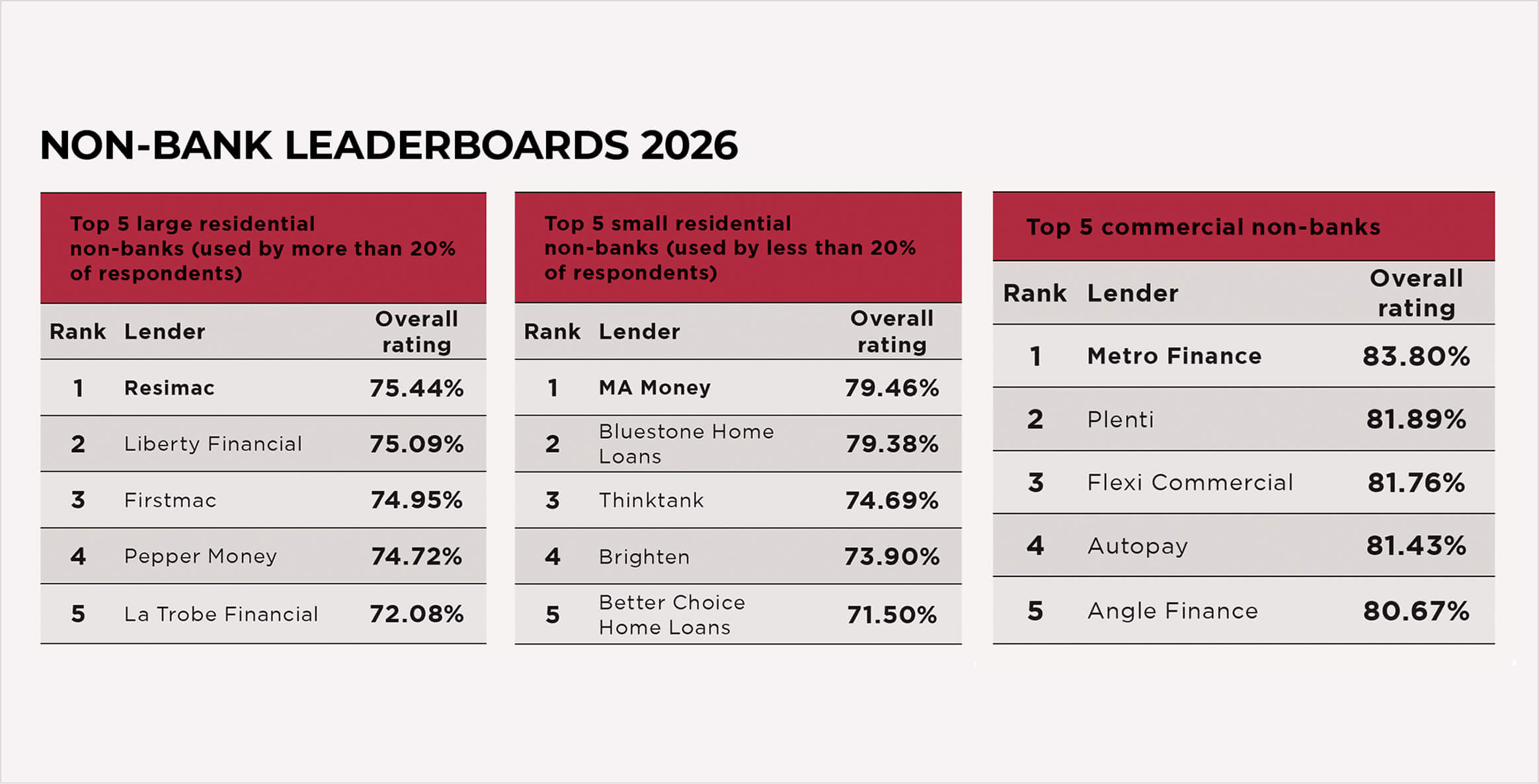
Topping the list of the larger non-banks (residential non-banks used by more than 20 per cent of brokers) was Pepper Money, with an average broker experience score of 75.35 per cent.
This was just decimal places higher than Liberty Financial (75.14 per cent), Firstmac (74.86 per cent), and Resimac (74.69 per cent). Coming in fifth place of the most frequently used non-banks was La Trobe Financial, with a score of 72.09 per cent.
This year’s result represents Pepper Money’s strongest performance since 2022, with the lender moving from mid-table to first or second place across the majority of attributes in its competitive set.
Pepper Money led its cohort in channel commitment with a score of 83 per cent and BDM quality at 80 per cent. The lender also topped its cohort in product range, application lodgement, and broker communication and training.
Agile Market Intelligence’s commercial director Oliver Stofka said: “Pepper Money’s 2026 result is a story of consistent improvement. While specialist lending remains a core strength, Pepper has been pushing hard into the prime market, and the scores reflect a lender broadening its proposition without losing what made it strong: BDM quality, credit assessment and genuine commitment to the broker relationship.
“What makes this result particularly notable is that broker perceptions have continued to improve despite a dip in turnaround times. In a survey where speed is one of the most scrutinised attributes, that’s no small feat.”
Small but mighty
For the less commonly used non-banks (used by less than 20 per cent of broker respondents), scores were much higher. MA Money topped the smaller residential non-banks with a score of 79.50 per cent, followed by Bluestone Home Loans (79.42 per cent), ORDE Financial (78.44 per cent), and RedZed (76.67 per cent).
MA Money scored 80 per cent across 16 attributes measured between February and April 2026. MA Money led its cohort in channel commitment with a score of 86 per cent and document submission with a rating of 81 per cent. The lender also topped its cohort in product policy, turnaround time, application lodgement, digital tools, and broker portal.
Stofka said: “MA Money’s jump from 68 per cent in 2024 to 80 per cent in 2026 is the most dramatic two-year improvement in the non-bank segment this year. In a cohort that includes lenders who have been building broker relationships for considerably longer, that kind of acceleration points to something deliberate. Topping the group in turnaround time and channel commitment simultaneously tells you the improvement is not concentrated in one area. It runs across the entire broker experience, and brokers have noticed.”
Commercial non-banks dominate
Commercial non-banks have also been increasing in broker popularity. In fact, according to the 2026 Third-Party Lending Report: Commercial Lending survey, which was conducted between February and April 2026, the top six-rated lenders by brokers were non- banks.
It found that Metro Finance was the highest-rated commercial lender of all 40 lenders assessed by brokers in the Commercial Lending survey. It had a broker experience score of 84 per cent. This was followed by Plenti and Flexi Commercial (both 82 per cent), Autopay (81 per cent), Angle Finance (81 per cent), and MoneyMe (80 per cent).
From the Commercial Lending survey, it was the products that the non-banks were offering that were most valued by brokers, closely followed by their technology.
Given that Australia continues to navigate a higher rate environment amid a changing regulatory landscape and a softening property market, the non-banks will likely continue to be called upon by brokers to provide solutions to borrowers, and fast.