

When The Adviser last examined green lending, it remained a relatively small segment of the lending market. But with cost-of-living pressures prompting borrowers to look more closely at household expenses, could energy savings be the catalyst for sustainable finance to break into the mainstream? Or is green lending destined to remain a niche?
Energy costs remain a concern for many households, with ABS data showing electricity prices rose 21.1 per cent in the 12 months to May 2026 – although the increase was largely driven by the expiry of Commonwealth and state government rebates.
Despite this, Stephanie Coleman, operations manager at Unconditional Finance, an NSW-based brokerage that offers sustainable lending options for clients, says she hasn’t observed a significant increase in the volume of inquiries over the past 12 months.
“The majority of our clients are still focused on borrowing capacity, interest rates and equity,” she says.
“Where sustainability does come into the conversation, it is often driven by clients who are planning to install solar, or purchase a newly built home with sustainable features.”
Coleman says inquiries tend to come primarily from younger owner-occupiers, first home buyers, or clients purchasing newly constructed properties that already meet higher energy-efficiency standards.
“We also occasionally see interest from borrowers planning major renovations, particularly where they’re looking to install solar panels, batteries or other energy-efficient upgrades,” she says.
“However, this remains a relatively small segment of our client base as we find most solar sales reps encourage clients to go with short-term finance options.”
In a recent appearance on The Adviser’s In Focus podcast, Zeb Drummond, chief operating officer at mutual lender Gateway Bank, also reflected on the sustainable finance landscape, saying cost remained the primary driver behind borrower interest.
“I think from a consumer perspective, cost is the focus,” he said. “At every turn for us we’re seeing people try to improve their costs from a family perspective, be it through their lending or through other initiatives as far as cost savings like energy efficiency.
“Energy has been on the forefront, I think, of everyone’s minds when it comes to cost of living in more recent times. And it’s certainly starting to resonate through our member base as well.”
Demand and appetite
One area where demand for sustainable finance has been particularly strong is green asset and equipment finance, which supports purchases such as electric vehicles (EVs).
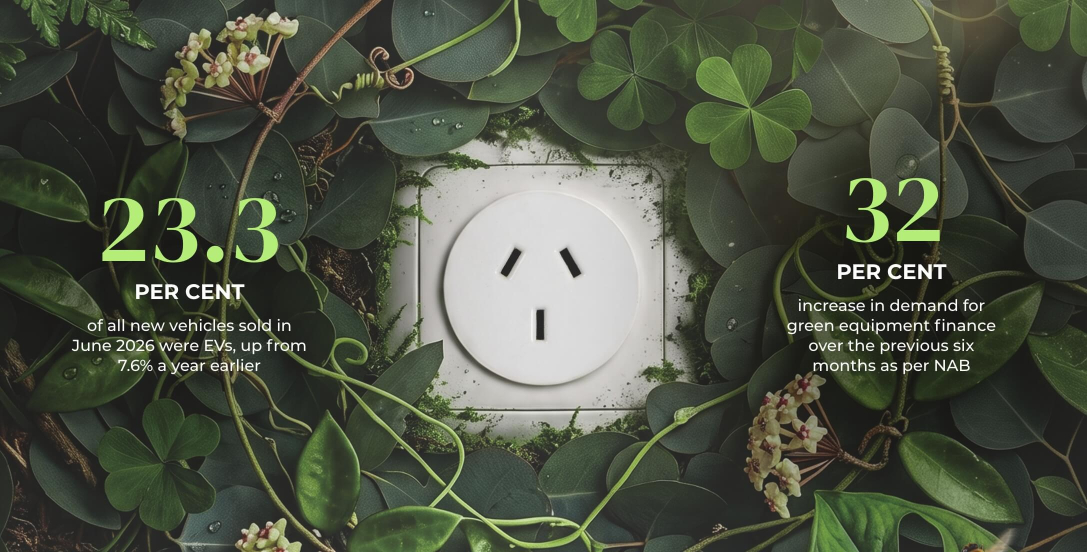
For example, National Australia Bank (NAB) reported a 32 per cent increase in demand for green equipment finance over the previous six months in data released in June.
In July, data from the Federal Chamber of Automotive Industries (FCAI) revealed a significant shift in the electric vehicle market, with battery electric vehicles (BEVs) accounting for 23.3 per cent of all new vehicle sales in June 2026.
This compares with 7.6 per cent in June 2025 and 8.4 percent in January 2026, representing almost a tripling of BEV market share in just six months.
On the home front, another significant development occurred in July, when the Australian government expanded the Nationwide House Energy Rating Scheme (NatHERS) to include existing homes, rather than just new homes and major renovations.
As the Mortgage & Finance Association of Australia (MFAA) says, the change also creates an opportunity for mortgage brokers to discuss sustainable finance options with clients.
“The expansion represents the biggest change to the scheme in its 33-year history and is expected to make Home Energy Ratings more accessible through faster assessments, updated software and an expanded network of accredited assessors,” the MFAA says.
“For mortgage and finance brokers, the expansion presents another opportunity to provide valuable guidance as clients increasingly seek advice that goes beyond securing a home loan.”
Awareness and opportunity
So, what is preventing sustainable finance from becoming more widely adopted among borrowers?
For Coleman, one challenge is the complexity involved in meeting eligibility criteria.
“Challenges include the sometimes complex eligibility criteria, valuation requirements, and limited availability for certain property types or locations,” she says.
“Certification and documentation can also be hurdles for some borrowers.”
Ultimately, she says borrower awareness could be another significant stumbling block.
“Generally, borrower awareness is still quite low. There’s definitely an opportunity for brokers to do more to educate clients about green lending options and benefits,” she says.
“I do expect demand for green lending to keep growing, especially as more incentives arrive and environmental concerns continue to rise.
I do expect demand for green lending to keep growing, especially as more incentives arrive and environmental concerns continue to rise
– Stephanie Coleman, operations manager, Unconditional Finance
“However, brokers can’t expect a lift in client inquiries, without educating them and raising awareness of the available green loan products.”
From a lender perspective, Drummond acknowledges there is more work to do to increase borrower awareness, but says education remains one of the biggest opportunities for growth.
“I think just greater awareness needs to happen, and we’ll continue to drive that through. But from an innovation perspective, it’s everywhere,” he says.
“For example, the longevity of batteries and the use of second-hand batteries to power houses is a key one. There may be more support from the government as we move forward as far as reducing the amount of waste that comes from batteries and EVs as well.
“My hope is that we get to a stage where we have greater electrification of households in Australia and more people are able to do so without it costing them more.”
Drummond also says borrowers are increasingly scrutinising every cost associated with buying a home, creating a natural opportunity for brokers to introduce green lending.
“I think it would be great if we got to a stage where every conversation included an element of what we are doing from a sustainability perspective,” he says.
“Certainly, that is what happens through our business at every turn – a conversation around sustainability and what we are doing at every single decision that we make as a business. “It would be a brilliant place to get to if brokers were having that similar conversation with customers around what their sustainability drivers actually are.
It won’t be to everybody and it won’t be to everybody on day one. But I think more and more, it’ll influence buying decisions.”